 Spiritual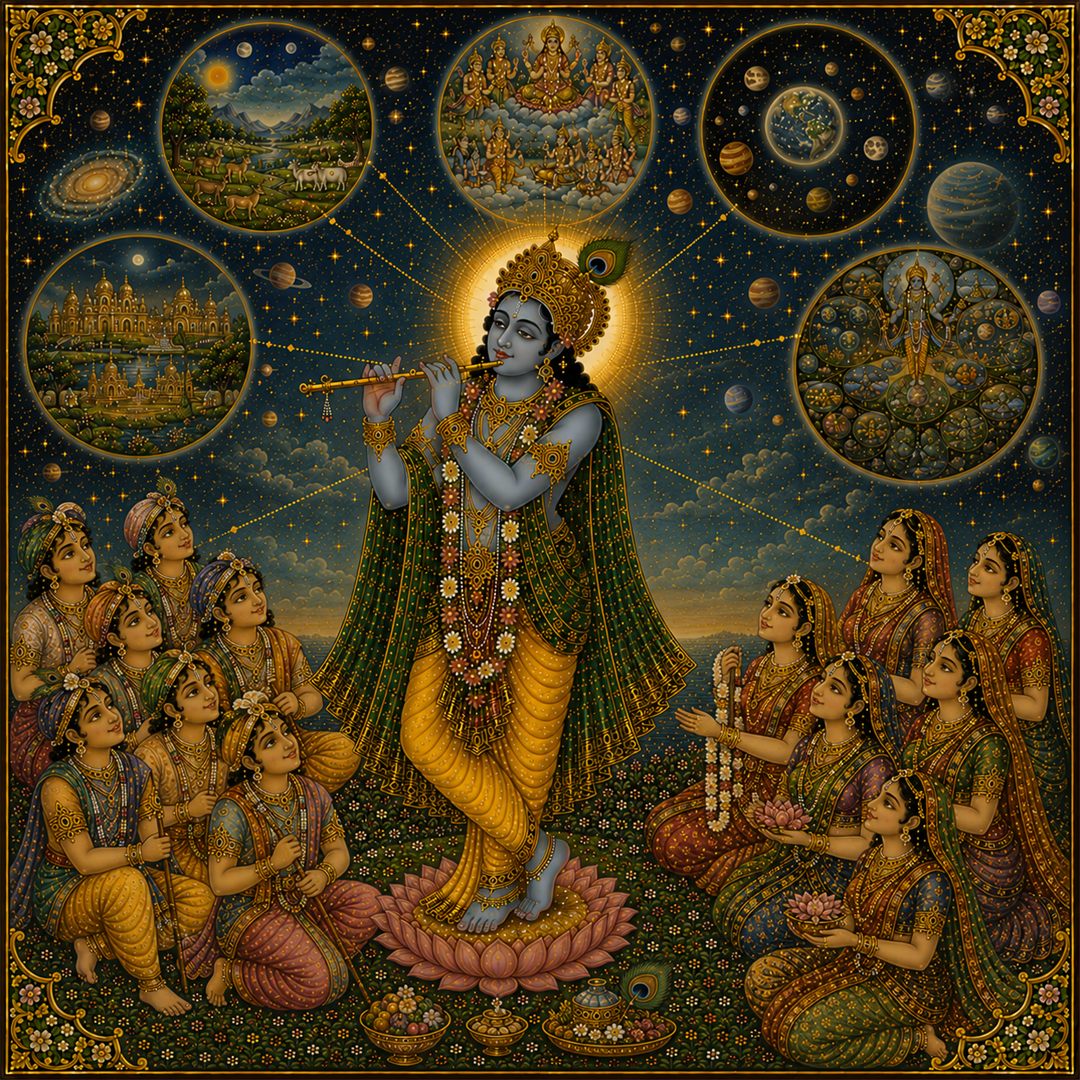
अङ्गानि यस्य सकलेन्द्रियवृत्तिमन्ति पश्यन्ति पान्ति कलयन्ति चिरं जगन्ति ।
आनन्दचिन्मयसदुज्ज्वलविग्रहस्य गोविन्दमादिपुरुषं तमहं भजामि ॥ ३२ ॥
aṅgāni yasya sakalendriya-vṛttimanti
paśyanti pānti kalayanti ciraṁ jaganti
ānanda-cinmaya-sad-ujjvala-vigrahasya
govindam ādi-puruṣaṁ tam ahaṁ bhajāmi
I worship Govinda, the primeval Lord, whose limbs possess the functions of all the senses and eternally see, sustain, and manifest the universes, and whose form, composed of consciousness and bliss, is eternally radiant.
aṅgāni—the limbs; yasya—whose; sakala-indriya-vṛttimanti—possessing the functions of all the senses; paśyanti—they see; pānti—they protect, sustain; kalayanti—they manifest; ciram—eternally, perpetually; jaganti—the worlds, the universes; ānanda—bliss; cinmaya—composed of consciousness; sat—eternally existent; ujjvala—radiant, effulgent; vigrahasya—whose form; govindam—Govinda; ādi-puruṣam—the primeval Lord; tam—Him; aham—I; bhajāmi—worship.
Dig-darśinī-ṭīkā
Śrī Jīva Gosvāmī
Having described those two kinds of pastimes, Brahmā now describes Govinda’s distinctive opulence, manifested through His supremely inconceivable potency, in four verses beginning with aṅgāni.
In the first of these verses, Brahmā describes Govinda’s form. Even His hands are able to see, His eyes are capable of sustaining and protecting, and likewise each limb is able to perform the function of every other limb.
Thus it is also said in the Bhagavad-gītā (13.14): sarvataḥ pāṇi-pādaṁ tat sarvato ‘kṣi-śiro-mukham. “Everywhere are His hands and feet; everywhere are His eyes, heads, and faces.”
With the word jaganti, “the universes,” the intended meaning is that, in relation to the associates and other constituents of His pastimes, each of His limbs acts just as Govinda Himself does. The cause of this extraordinary capacity is the distinctive nature of His form, indicated by the words ānanda-cinmaya: composed of consciousness and bliss.
Brahma-saṁhitā-prakāśinī
Śrīla Bhaktivinoda Ṭhākura
Verse 32
I worship Govinda, the primeval Lord, whose form is composed of bliss, consciousness, and eternal existence, and is therefore supremely effulgent. Every limb of His form possesses all the functions of all the senses, and eternally sees, maintains, and manifests the innumerable spiritual and material worlds.
In the absence of tasting spiritual reality (cid-āsvāda), a grave doubt arises within persons conditioned by materialistic knowledge. Hearing descriptions of Kṛṣṇa’s pastimes, they think that learned people have merely projected the idea of Kṛṣṇa from material experience through poetic imagination.
To dispel this harmful misconception, Brahmā, in this verse and the next three, carefully explains the distinction between spirit and matter through philosophical analysis. In this way, he establishes Kṛṣṇa’s pastimes as perceived in pure spiritual absorption (śuddha-samādhi).
Brahmā’s intention is to convey the following understanding:
Kṛṣṇa’s form is composed of eternity, consciousness, and bliss (sac-cid-ānanda), whereas all material perceptions are composed of inert darkness born of māyā.
Although spirit and matter display certain superficial similarities in variety and differentiation, the essential truth is that conscious spiritual reality is the original substance. Variety and diversity eternally exist within it. Upon that spiritual variety are established Kṛṣṇa’s spiritual abode, spiritual form, spiritual name, qualities, and pastimes.
Only those endowed with pure spiritual awareness and freed from contact with māyā can truly perceive and relish those pastimes.
The spiritual abode, the pastime realm composed of cintāmaṇi manifested by the spiritual potency, and Kṛṣṇa’s form are all completely spiritual.
Just as māyā is the shadow of the spiritual potency, so the varieties found in the material world are likewise inferior reflections or shadows of spiritual variety. Thus only a resemblance to the variety of spiritual reality is perceived within the material world.
Although both spiritual and material realms display variety, they are fundamentally distinct. The defect of matter lies precisely in its inferior quality, whereas spiritual reality possesses variety completely free from such defect. Kṛṣṇa’s self and body are not different from one another. In conditioned souls, however, body and self are distinct. In spiritual reality there is no distinction between the body and the possessor of the body, limb and whole, attributes and the possessor of attributes. But in material existence such distinctions exist in conditioned beings.
Although Kṛṣṇa possesses limbs, each of His limbs is complete Kṛṣṇa Himself. All spiritual functions are present in every one of His limbs. Therefore He is indivisible, complete consciousness.
Both the jīva and Kṛṣṇa are conscious spiritual entities and are thus similar in nature. The difference is that in the jīva these qualities exist in atomic measure, whereas in Kṛṣṇa they exist infinitely.
When the soul attains its pure spiritual condition, those qualities become manifest within it in minute measure. When, by Kṛṣṇa’s mercy, the power of the spiritual hlādinī-śakti manifests within the soul, it attains a perfected likeness to the infinite.
Even so, because of certain unique qualities, Kṛṣṇa alone remains the supreme object of worship. Those four unique qualities are not manifested even in the Lords of Vaikuṇṭha or the puruṣa-avatāras, what to speak of demigods like Śiva or ordinary living beings.
Annotations
Bhakti Gauravani Goswami
The four unique qualities (catuḥ-viśeṣa-mādhurya) mentioned by Bhaktivinoda Ṭhākura that distinguish Kṛṣṇa even from Nārāyaṇa in Vaikuṇṭha and the puruṣa-avatāras are:
1. Līlā-mādhurya—Kṛṣṇa is an ocean of sweet and wonderful pastimes.
2. Prema-mādhurya—Kṛṣṇa is surrounded by devotees possessing incomparable sweet love for Him.
3. Veṇu-mādhurya—Kṛṣṇa’s flute song is so sweet and enchanting that it captivates the mind of everyone in the three worlds.
4. Rūpa-mādhurya—Kṛṣṇa’s bodily beauty is so sweet and incomparable that it astonishes all moving and nonmoving beings.