 Spiritual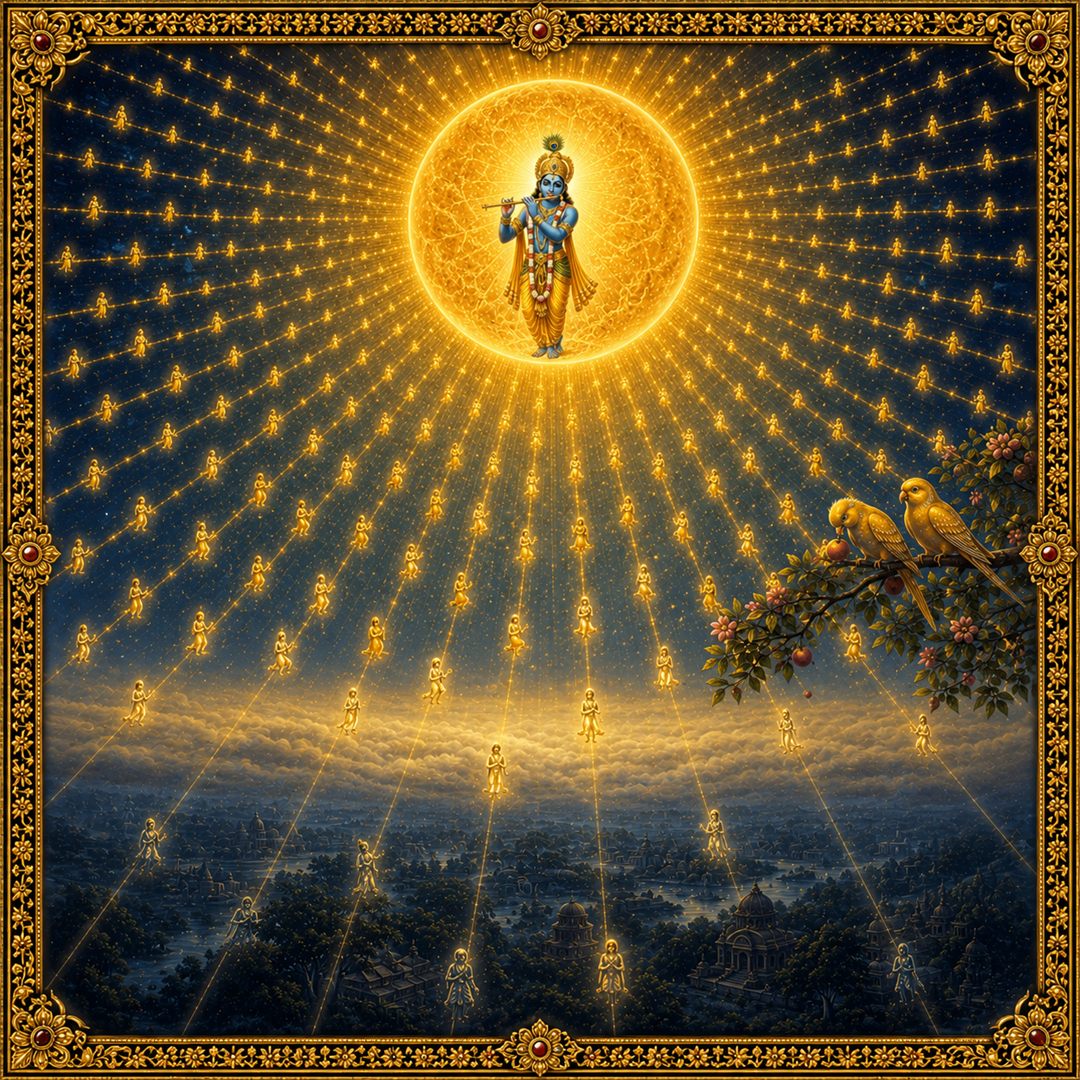
स नित्यो नित्यसम्बन्धः प्रकृतिश्च परैव सा ॥ २१ ॥
sa nityo nitya-sambandhaḥ prakṛtiś ca paraiva sā
The jīva is eternal, possesses an eternal relationship, and is indeed the superior potency.
saḥ— he, the jīva; nityaḥ—eternal; nitya-sambandhaḥ—possessing an eternal relationship; prakṛtiḥ—potency, nature; ca—and; parā—superior, spiritual; eva—indeed; sā—that potency.
Dig-darśinī-ṭīkā
Jīva Gosvāmī
With the half verse beginning sa nityaḥ, Brahmā describes the natural relationship between Bhagavān and the living entity. The word saḥ refers to the jīva. The word nityaḥ indicates that the jīva exists throughout beginningless and endless time.
The word nitya-sambandhaḥ indicates that the jīva has an eternal and inseparable relationship with Bhagavān, like the relationship between the Sun and its rays.
This has been stated in the Nārada-pañcarātra:
yat taṭasthaṁ tu cid-rūpaṁ saṁvedāt tu vinirgatam
rañjitaṁ guṇa-rāgeṇa sa jīva iti kathyate.
“That marginal entity who is of the nature of consciousness, who has emanated from consciousness, and who is colored by attachment to the guṇas is called the jīva.”
Similarly, in the Gītā (15.7), Kṛṣṇa says:
mamaivāṁśo jīva-loke jīva-bhūtaḥ sanātanaḥ.
“The living entities in this conditioned world are My eternal fragmental parts.”
Thus the word prakṛti applies to the jīva. As the witness (sākṣī), he remains situated in his own nature; yet as the knower (pramātṛ), he assumes a condition resembling prakṛti, in accordance with the relationship between an original and its reflection (bimba-pratibimba). For this very reason, Kṛṣṇa also says in the Gītā (7.5):
prakṛtiṁ viddhi me parām jīva-bhūtāṁ mahā-bāho
“O mighty-armed one, know My superior prakṛti, which consists of the living entities.”
The Śruti also demonstrates this eternal relationship by saying: dvā suparṇā sayujā sakhāyā. “Two birds, united companions.” (Śvetāśvatara Upaniṣad 4.6)
Brahma-saṁhitā-prakāśinī
Bhaktivinoda Ṭhākura
Verse 21
The jīva is eternal and has an eternal relationship with Bhagavān spanning beginningless and endless time. The living entity is indeed the superior potency.
Just as the Sun and its rays have an eternal relationship, so Bhagavān, the spiritual Sun, and the jīvas are eternally related. The jīvas are particles of His spiritual rays and are therefore not temporary like material objects. As particles of those rays, they possess minute portions of Kṛṣṇa’s qualities. Consequently, the jīva is of the nature of knowledge (jñāna), is a knower (jñātṛ), has a sense of individual existence, or "I"-awareness (ahaṁtā-bhāva), and is an enjoyer (bhoktṛ), a thinker (mantṛ), and a doer (kartṛ).
Kṛṣṇa is infinite (vibhu), whereas the living being is infinitesimal (aṇu). This is the defining distinction between them. The eternal relationship between the jīva and Bhagavān is that the jīva is eternally His servant and Bhagavān is eternally the jīva’s master. The jīva also possesses sufficient eligibility to exchange rasa with Bhagavān.
In the Bhagavad-gītā (7.5), Kṛṣṇa says:
apareyam itas tv anyāṁ prakṛtiṁ viddhi me parām.
“Besides this inferior nature, know My other, superior potency.”
It is therefore understood that the jīva is Kṛṣṇa’s superior potency. All the qualities of the pure jīvātmā transcend the eight constituents of the inferior potency, including ahaṅkāra. Therefore, although the jīva-śakti is minute, it is superior to the māyā-śakti.
Another name for this potency is taṭastha-śakti, meaning that it is situated on the boundary line between māyā and cit-tattva. Because of its atomic nature, it is susceptible to the control of māyā. If it remains under Kṛṣṇa, the Lord of māyā, however, it need not come under māyā’s control. Only the jīva bound by beginningless māyā suffers the miseries of saṁsāra and undergoes repeated birth and death.
Annotations
Bhakti Gauravani Goswami
The expression taṭastha-śakti, “marginal potency,” should not be understood as describing a geographical location between the spiritual and material worlds. It describes the constitutional category of the jīva. The designation parā prakṛti, “superior potency,” distinguishes the conscious living entity from the inferior material potency; it does not identify the jīva with Bhagavān or His internal potency. Although the jīva is spiritual, it is infinitesimal and may therefore come under the influence of māyā.
Bhaktivinoda Ṭhākura explains this condition by describing the jīva as situated on the taṭa, or margin, between the domains of spirit and matter. The point is not physical position but potential orientation. The jīva may remain under Kṛṣṇa’s shelter or become subject to māyā. This capacity for orientation reflects the minute independence of the living entity.
Bhaktivinoda Ṭhākura’s inclusion of ahaṁtā-bhāva, the sense of “I,” among the natural qualities of the pure jīva should not be confused with the material ahaṅkāra described in Verse 16. Ahaṁtā-bhāva is the soul’s genuine awareness of its existence and eternal identity as Bhagavān’s servant. Material ahaṅkāra misidentifies the self with the body and mind and regards it as an independent doer and enjoyer.