 Spiritual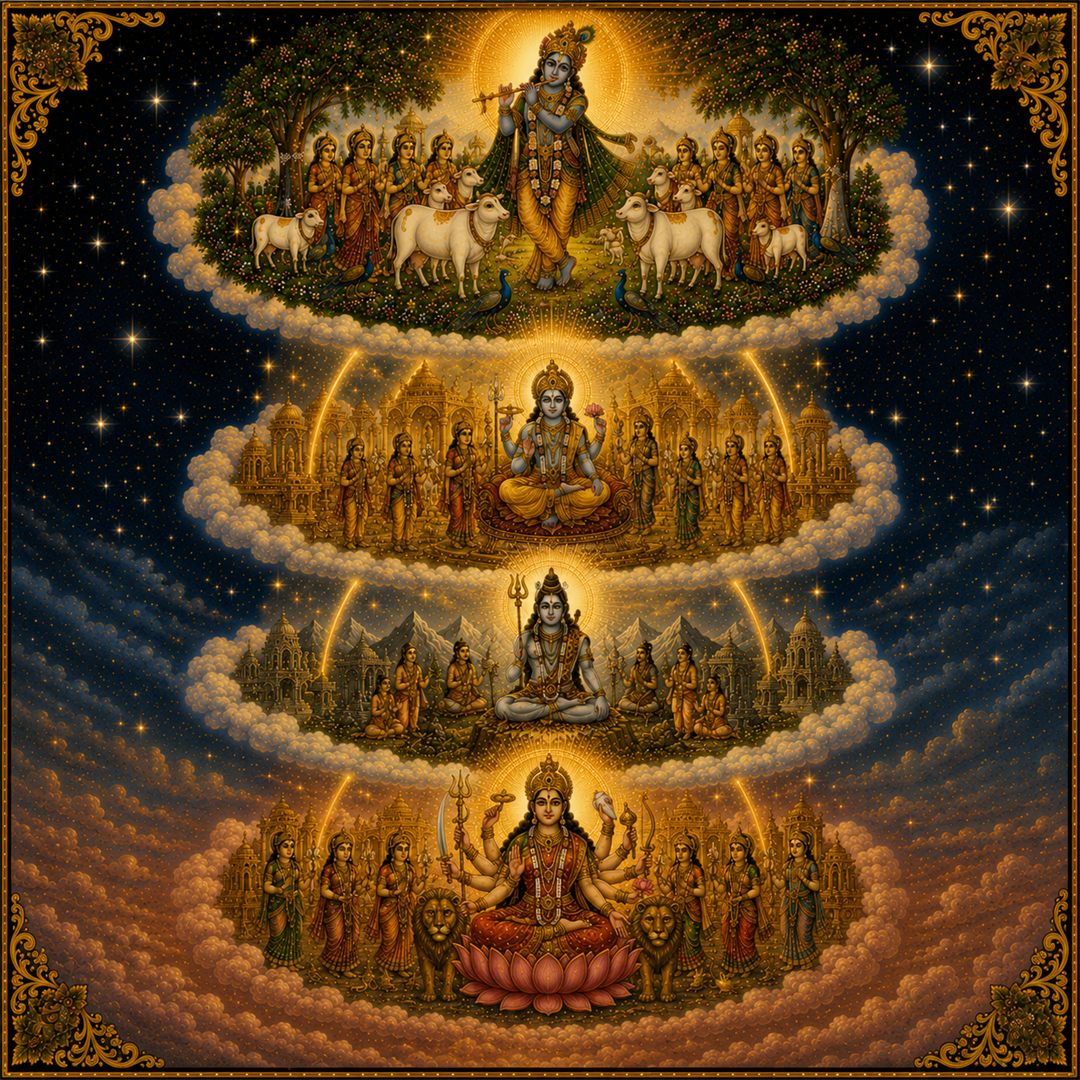
गोलोकनाम्नि निजधाम्नि तले च तस्य देवीमहेशहरिधामसु तेषु तेषु ।
ते ते प्रभावनिचया विहिताश्च येन गोविन्दमादिपुरुषं तमहं भजामि ॥ ४३ ॥
goloka-nāmni nija-dhāmni tale ca tasya
devī-maheśa-hari-dhāmasu teṣu teṣu
te te prabhāva-nicayā vihitāś ca yena
govindam ādi-puruṣaṁ tam ahaṁ bhajāmi
I worship Govinda, the primeval Lord, by whom the respective powers and glories have been established in His own abode known as Goloka, and in the realms of Devī, Maheśa, and Hari situated beneath it.
goloka-nāmni—named Goloka; nija-dhāmni—in His own abode; tale ca tasya—and below it; devī-maheśa-hari-dhāmasu—in the realms of Devī, Maheśa, and Hari; teṣu teṣu—within each of those; te te—their respective; prabhāva-nicayāḥ—collections of powers and glories; vihitāḥ—established, arranged; ca—and; yena—by whom; govindam—Govinda; ādi-puruṣam—the primeval Lord; tam—Him; ahaṁ bhajāmi—I worship.
Dig-darśinī-ṭīkā
Śrī Jīva Gosvāmī
Having described the Lord’s glory as manifested within the material creation, Brahmā now describes the glory of Govinda’s eternal abode. Thus the verse begins: goloka-nāmni. The enumeration of Devī-dhāma, Maheśa-dhāma, Hari-dhāma, and Goloka should be understood in reverse order, from lowest to highest. Each successive realm possesses greater glory than the one below it, and therefore each higher realm is situated above the preceding one.
Goloka has already been established as the highest of all realms and as all-pervading in relation to the others. Earlier it was also shown that Vṛndāvana manifest on Earth is non-different from Goloka.
Indeed, this identity is indicated in the following verse:
sa tu lokas tvayā kṛṣṇa sīdamānaḥ kṛtātmanā
dhṛto dhṛtimatā vīra nighnato ‘padravān gavām
“O Kṛṣṇa, O hero, that realm, though sinking, was upheld by You, the resolute and perfected one, when You destroyed the disturbances threatening the cows.”1
Thus the statement goloka eva nivasati, “He resides exclusively in Goloka,” is perfectly appropriate, because Scripture also describes Him as eternally performing His pastimes in Vṛndāvana manifest on Earth. For example, the Ādi-varāha Purāṇa states: “The twelve forests of Vṛndāvana are protected by Vṛndā-devī. They are presided over by Hari and worshiped by Brahmā, Rudra, and others.” And further: “The bridge constructed by Kṛṣṇa for His pastimes destroys the greatest sins. Having created it for sporting with the cowherd girls, Lord Gadādhara remains there with the cowherd boys for a moment every day. Indeed, He continually goes there for His enjoyment.”2
Similarly, in the Gautamīya-tantra, Nārada asks: “O Lord of men, what is this Vṛndāvana consisting of thirty-two forests? If I am qualified to hear, please explain it to me.” Śrī Kṛṣṇa replies: “This place known as Vṛndāvana is exclusively My abode. The animals, birds, deer, insects, and even the most fallen human beings who dwell here and die while absorbed in Me attain My abode. The cowherd girls who dwell here in My abode are My gopīs, eternally devoted to My service. This forest extends for five yojanas and is My very bodily form. The Yamunā, known as Suṣumnā, carries the supreme nectar. Here the demigods and other beings dwell in subtle forms. I am present here as the embodiment of all the demigods and never abandon this forest. In every age My appearance and disappearance take place here. This charming realm is composed of spiritual effulgence and cannot be seen with material eyes.”
It is on the basis of this very form of Vraja that the eternal kadamba trees and other features described in the Varāha Purāṇa and elsewhere are to be understood. Therefore one should conclude that the Vṛndāvana visible to us and Goloka are one and the same reality. Goloka is simply this very Vṛndāvana in its transcendental manifestation beyond the range of ordinary vision.
When Śrī Kṛṣṇa appears there together with His associates within the manifest realm visible to us, that appearance is called His avatāra. For the nourishment of particular rasas, various pastimes of union, separation, reunion, and other wonderful exchanges are then enacted. The conventions of the gopīs’ apparently belonging to others, and similar features, are also to be understood in this context. Whenever distinctions are described here or elsewhere, for example in the Kalpa-tantra, Yāmala, Saṁhitās, Pañcarātras, and other works, they should be interpreted according to this understanding.
Thus the Tenth Canto of the Śrīmad-Bhāgavatam (10.90.48) states:
jayati jana-nivāso devakī-janma-vādo
yadu-vara-pariṣat svair dorbhir asyann adharmam
sthira-cara-vṛjina-ghnaḥ su-smita-śrī-mukhena
vraja-pura-vanitānāṁ vardhayan kāma-devam
“All glory to Him who is the dwelling place of all beings, who is spoken of as having been born from Devakī, who, surrounded by the foremost Yadus, casts away irreligion with His own arms, who destroys the sufferings of all moving and nonmoving beings, and whose beautiful smiling face increases the amorous desire of the women of Vraja.”
And in the Padma Purāṇa, Nirvāṇa-khaṇḍa, Vyāsa says: “Look! I shall show you the form concealed within the Vedas.” Then he beholds “a cowherd boy dark like a raincloud, surrounded by cowherd girls and laughing among the cowherd boys.” The use of the word kanyā, “maiden,” indicates that these gopīs are not to be understood as having attained the ordinary worldly condition of married womanhood.
Similarly, the Fourth Chapter of the Gautamīya-tantra describes meditation on Vṛndāvana like this: “One should meditate upon Vṛndāvana as adorned with hundreds of maidens who seem to have descended from heaven, filled with cowherds, calves, and groves of trees, and worshiped by thousands of cowherd girls with eyes like lotus petals, who offer flowers of spiritual emotion to the Supreme Lord, the sole spiritual master of the three worlds.”
The same text also says: “A practitioner who constantly chants the mantra with controlled mind will undoubtedly behold Hari in the form of a cowherd boy.”
And elsewhere: “The wise person should reside in Vṛndāvana until he obtains the vision of Kṛṣṇa.” Likewise, the Trailokya-sammohana-tantra states: “The practitioner who chants with concentrated mind will undoubtedly see Hari dressed as a cowherd boy.”
Therefore Brahmā says in the Gopāla-tāpanī Upaniṣad: “While I performed brahma-savana, the meditative worship of Brahman, contemplating and praising Him, at the end of a vast period the Supreme Person became known to me and appeared before me in the dress of a cowherd boy.”
Therefore, whenever Scripture speaks of Kṛṣṇa as appearing through forms such as Kṣīrodakaśāyī Viṣṇu, this should be understood with reference to the entrance of His expansions into those forms.
For a fuller discussion of these matters, one should consult the Kṛṣṇa-sandarbha.
Brahma-saṁhitā-prakāśinī
Śrīla Bhaktivinoda Ṭhākura
Verse 43
I worship that primeval Lord Govinda, who has established the respective potencies and glories of the various realms: Devī-dhāma, above it Maheśa-dhāma, above it Hari-dhāma, and above all His abode known as Goloka.
Goloka-dhāma is situated above all other realms. Brahmā, perceiving that abode above all others, describes the intermediary realms from the position of his residence.
First is Devī-dhāma, the material world. Within it are the fourteen planetary systems headed by Satyaloka. Above that is Maheśa-dhāma, or Śiva-dhāma. One portion of that realm is known as Mahākāla-dhāma and is enveloped in darkness. Beyond that region lies the brilliantly effulgent abode of Sadāśiva.3
Above that is Hari-dhāma, the spiritual world consisting of the Vaikuṇṭha planets.
The characteristic glory of Devī-dhāma is the opulence of Māyā. The characteristic glory of Śiva-dhāma consists of time (kāla), the arrangement of material elements, and reflected manifestations of the Lord’s personal expansions appearing among His separated expansions. The characteristic glory of Hari-dhāma is spiritual majesty (cid-aiśvarya). The characteristic glory of Goloka is supreme sweetness (mahā-mādhurya), which is the abode of all opulences.
Govinda Himself has established all these respective glories within their respective realms, both directly and through His secondary agencies.
Annotations
Bhakti Gauravani Goswami
The illustration accompanying this verse depicts the four realms as arranged one above another in a vertical hierarchy. Their actual relationship, however, is more subtle. Devī-dhāma is the material universe; Maheśa-dhāma is the intermediate realm at the boundary between the material and spiritual domains; Hari-dhāma is the spiritual world characterized by divine majesty; and Goloka is the abode of supreme sweetness.
Their relationship cannot be adequately understood in terms of ordinary three-dimensional space. They exist on distinct ontological levels and represent progressively fuller manifestations of divine reality and correspondingly deeper revelations of the Absolute Truth. The vertical arrangement therefore serves only as a visual aid, not as a geographical map of physical space.
This perspective may help us understand the statement in Verse 34 that even if one could travel for one billion years at the speed of the wind or the mind, one would still be unable to attain the lotus feet of Govinda. The higher realms are not reached merely by movement through physical space. Rather, they become accessible and are revealed according to the soul’s spiritual qualification and realization. Govinda is revealed through bhakti and attained in fullness through prema-bhakti, devotion imbued with pure love.
Notes
- When Indra, the king of heaven, surrendered to Kṛṣṇa after Kṛṣṇa had raised Govardhana Hill, he offered this prayer which is found in the Vedic Scripture Hari-vaṁśa (Viṣṇu-parva, Chapter 19). ↩
- The bridge mentioned here is a traditional site in Vṛndāvana known as Setu-bandha or Setu-bandha-kuṇḍa. During His pastimes, Kṛṣṇa manifested a bridge there to demonstrate to the gopīs that He is the same person as Rāmacandra. Jīva Gosvāmī cites this passage to show that Kṛṣṇa eternally visits this place in His Vṛndāvana pastimes and, consequently, that manifest Vṛndāvana and Goloka are one and the same spiritual reality. ↩
- Śiva-dhāma is an intermediate realm situated between the material world (Devī-dhāma) and the spiritual world (Hari-dhāma). One aspect of this realm, called Mahākāla-dhāma, is associated with cosmic time and the interface between spirit and matter, whereas beyond it lies the effulgent abode of Sadāśiva. ↩