 Spiritual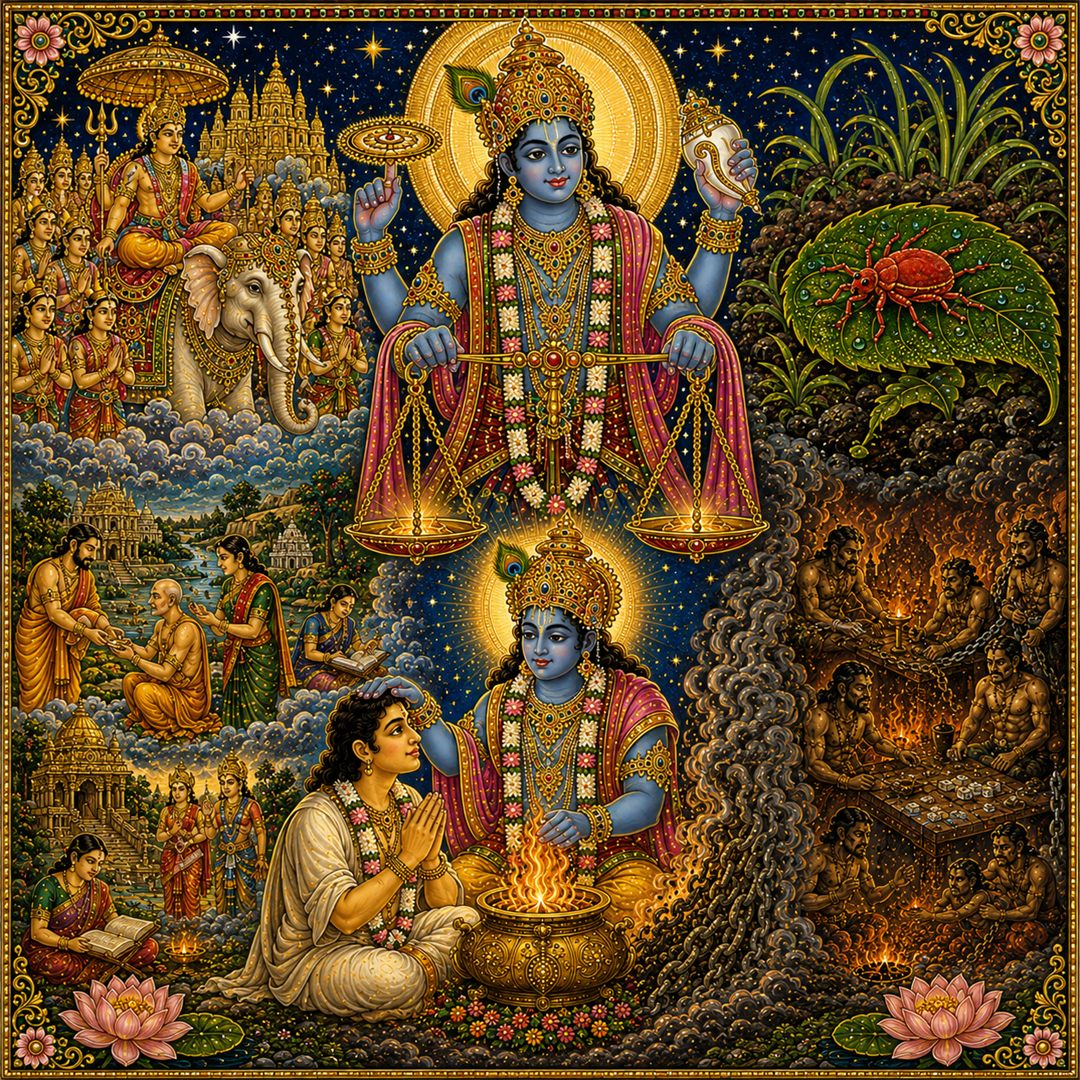
यस्त्विन्द्रगोपमथवेन्द्रमहः स्वकर्मबन्धानुरूपफलभाजनमातनोति ।
कर्माणि निर्दहति किन्तु च भक्तिभाजां गोविन्दमादिपुरुषं तमहं भजामि ॥ ५४ ॥
yas tv indra-gopam athavendram aho sva-karma-
bandhānurūpa-phala-bhājanam ātanoti
karmāṇi nirdahati kintu ca bhakti-bhājāṁ
govindam ādi-puruṣaṁ tam ahaṁ bhajāmi
I worship Govinda, the primeval Lord, who awards to all living beings—from the tiny Indragopa insect up to Indra—the results corresponding to the bondage of their own karma. Yet, astonishingly, He burns up the karma of those who possess devotion to Him.
yaḥ tu—but He who; indra-gopam—the tiny insect called Indragopa; athavā indram—or even Indra; aho—indeed, astonishingly; sva-karma-bandha-anurūpa—corresponding to the bondage of one’s own karma; phala-bhājanam—the recipient of results; ātanoti—awards; karmāṇi—karmas, karmic reactions; nirdahati—burns up completely; kintu ca—but indeed; bhakti-bhājām—of those who possess devotion; govindam—Govinda; ādi-puruṣam—the primeval Lord; tam—Him; ahaṁ bhajāmi—I worship.
Dig-darśinī-ṭīkā
Śrī Jīva Gosvāmī
Although the Supreme Lord is equal in awarding results according to karma, according to the principle that He is like a rain cloud, He nevertheless shows special favor toward His devotee. Thus the verse says: yas tv indra-gopam...
In the Bhagavad-gītā (9.29) Kṛṣṇa states:
samo ‘haṁ sarva-bhūteṣu na me dveṣyo ‘sti na priyaḥ
ye bhajanti tu māṁ bhaktyā mayi te teṣu cāpy aham
“I am equal toward all beings. No one is hateful or dear to Me. But those who worship Me with devotion dwell in Me, and I also dwell in them.”
And He also says (Bg. 9.22):
ananyāś cintayanto māṁ ye janāḥ paryupāsate
teṣāṁ nityābhiyuktānāṁ yoga-kṣemaṁ vahāmy aham
“Those who always worship Me with exclusive devotion, meditating upon Me alone—I personally carry what they lack and preserve what they possess.”
Brahma-saṁhitā-prakāśinī
Śrīla Bhaktivinoda Ṭhākura
Verse 54
Whether it be the tiny insect known as the Indragopa or Indra, the king of the demigods, Govinda impartially awards to the living beings bound by karma the results corresponding to their respective bondage of actions. Yet, astonishingly, He completely burns away the karma of His devotees. I worship that primeval Lord, Govinda.
In awarding the results of karma to the conditioned living beings, the Supreme Lord remains completely impartial, causing future activities to arise from the actions the jīvas have performed in the past. However, out of special mercy toward His devotees, He burns up their pious and impious activities together with the very root of karma, namely the desire for fruitive action (karma-vāsanā) and ignorance (avidyā).
Although karma is beginningless, it is nevertheless subject to destruction. The karma of those who perform works with a desire for their fruits becomes inexhaustible; it never comes to an end. Even the religious duties of the renounced order (sannyāsa-dharma) constitute a particular type of prescribed action. Since such practices are often accompanied by a desire for liberation as their fruit, they are not pleasing to Kṛṣṇa. Such persons also receive results corresponding to their actions, and even if they are completely free from material desires, they attain only the insignificant result of self-satisfaction (ātmārāmatā).
Pure devotees, however, being free from all other desires, abandon independent endeavors on the paths of knowledge and fruitive work and continuously cultivate devotional service to Kṛṣṇa in a favorable mood. Kṛṣṇa completely destroys the karma, the desire for karma, and the ignorance of such persons.
The remarkable point is that although Kṛṣṇa is impartial, He nevertheless shows a special inclination toward His devotees.
Annotations
Bhakti Gauravani Goswami
The question of whether God is impartial or shows favor to some is not new.
Mahārāja Parīkṣit raises this question to Śukadeva Gosvāmī at the beginning of the Seventh Canto. He inquired:
My dear brāhmaṇa, the Supreme Personality of Godhead, Viṣṇu, being everyone’s well-wisher, is equal and extremely dear to everyone. How, then, did He become partial like a common man for the sake of Indra and thus kill Indra’s enemies? How can a person equal to everyone be partial to some and inimical toward others?
In the purport to this verse (SB 7.1.1), Śrīla Prabhupāda writes:
In Bhagavad-gītā (9.29) the Lord says, samo ’haṁ sarva-bhūteṣu na me dveṣyo ’sti na priyaḥ: “I am equal to everyone. No one is dear to Me, nor is anyone My enemy.” In the previous canto, however, it has been observed that the Lord sided with Indra by killing the demons on his account (hata-putrā ditiḥ śakra-pārṣṇi-grāheṇa viṣṇunā). Therefore, the Lord was clearly partial to Indra, although He is the Supersoul in everyone’s heart. The soul is extremely dear to everyone, and similarly the Supersoul is also dear to everyone. Thus there cannot be any faulty action on the part of the Supersoul. The Lord is always kind to all living entities, irrespective of form and situation, yet He took the side of Indra just like an ordinary friend. This was the subject of Parīkṣit Mahārāja’s inquiry. As a devotee of Lord Kṛṣṇa, he knew very well that Kṛṣṇa cannot be partial to anyone, but when he saw that Kṛṣṇa acted as the enemy of the demons, he was somewhat doubtful. Therefore he posed this question to Śukadeva Gosvāmī for a clear answer.
A devotee cannot accept that Lord Viṣṇu has material qualifications. Mahārāja Parīkṣit knew perfectly well that Lord Viṣṇu, being transcendental, has nothing to do with material qualities, but to confirm his conviction he wanted to hear from the authority Śukadeva Gosvāmī. Śrīla Viśvanātha Cakravartī Ṭhākura says, samasya kathaṁ vaiṣamyam: since the Lord is equally disposed toward everyone, how can He be partial? Priyasya katham asureṣu prīty-abhāvaḥ. The Lord, being the Supersoul, is extremely dear to everyone. Why, then, should the Lord display unsympathetic behavior toward the asuras? How is this impartial? Suhṛdaś ca kathaṁ teṣv asauhārdam. Since the Lord says that He is suhṛdaṁ sarva-bhūtānām, the well-wisher of all living entities, how could He act with partiality by killing demons? These questions arose in the heart of Parīkṣit Mahārāja, and therefore he inquired from Śukadeva Gosvāmī.
Verse 54 of the Brahmā-saṁhitā may raise a similar doubt. Here also Govinda is described as impartial, awarding the results of karma equally to all living beings, from the insignificant indragopa insect to mighty Indra, the king of heaven. Every living entitiy receives the consequences of its actions according to the infallible law of karma.
Yet in the second half of the verse Brahmā declares that Govinda burns away the karma of His devotees. How can the Lord be both impartial and partial at the same time?
The answer is that Kṛṣṇa does not arbitrarily suspend the law of karma to favor His devotees. Rather, loving devotional service itself establishes a new relationship between the individual soul and the Supreme Soul. When a living entity voluntarily turns toward Kṛṣṇa and places itself under His shelter, Kṛṣṇa personally takes responsibility for that soul. Thus He says in the Bhagavad-gītā (9.22): “Those who always worship Me with exclusive devotion, meditating upon Me alone, I personally carry what they lack and preserve what they possess.” And later, in Text 29, He claims: “I envy no one, nor am I partial to anyone. I am equal to all. But whoever renders service unto Me in devotion is a friend, is in Me, and I am also a friend to him.”
In the purport to this verse, Prabhupāda explains that Kṛṣṇa’s apparent partiality is not material discrimination, but natural personal reciprocation:
One may question here that if Kṛṣṇa is equal to everyone and no one is His special friend, then why does He take a special interest in the devotees who are always engaged in His transcendental service? But this is not discrimination; it is natural. Any man in this material world may be very charitably disposed, yet he has a special interest in his own children. The Lord claims that every living entity—in whatever form—is His son, and so He provides everyone with a generous supply of the necessities of life. He is just like a cloud which pours rain all over, regardless of whether it falls on rock or land or water. But for His devotees, He gives specific attention. Such devotees are mentioned here: they are always in Kṛṣṇa consciousness, and therefore they are always transcendentally situated in Kṛṣṇa. The very phrase “Kṛṣṇa consciousness” suggests that those who are in such consciousness are
living transcendentalists, situated in Him. The Lord says here distinctly, mayi te: “They are in Me.” Naturally, as a result, the Lord is also in them. This is reciprocal. This also explains the words ye yathā māṁ prapadyante tāṁs tathaiva bhajāmy aham: “Whoever surrenders unto Me, proportionately I take care of him.” This transcendental reciprocation exists because both the Lord and the devotee are conscious. When a diamond is set in a golden ring, it looks very nice. The gold is glorified, and at the same time the diamond is glorified. The Lord and the living entity eternally glitter, and when a living entity becomes inclined to the service of the Supreme Lord he looks like gold. The Lord is a diamond, and so this combination is very nice. Living entities in a pure state are called devotees. The Supreme Lord becomes the devotee of His devotees. If a reciprocal relationship is not present between the devotee and the Lord, then there is no personalist philosophy. In the impersonal philosophy there is no reciprocation between the Supreme and the living entity, but in the personalist philosophy there is.
The conclusion is that the destruction of karma mentioned in this verse is not a sign of unjust preferential treatment. It is a sign of the Lord’s reciprocal relationship with His devotees. When Kṛṣṇa says, “As all surrender unto Me, I reward them accordingly,” He remains equal to all, yet responds according to the disposition with which each individual approaches Him.