 Spiritual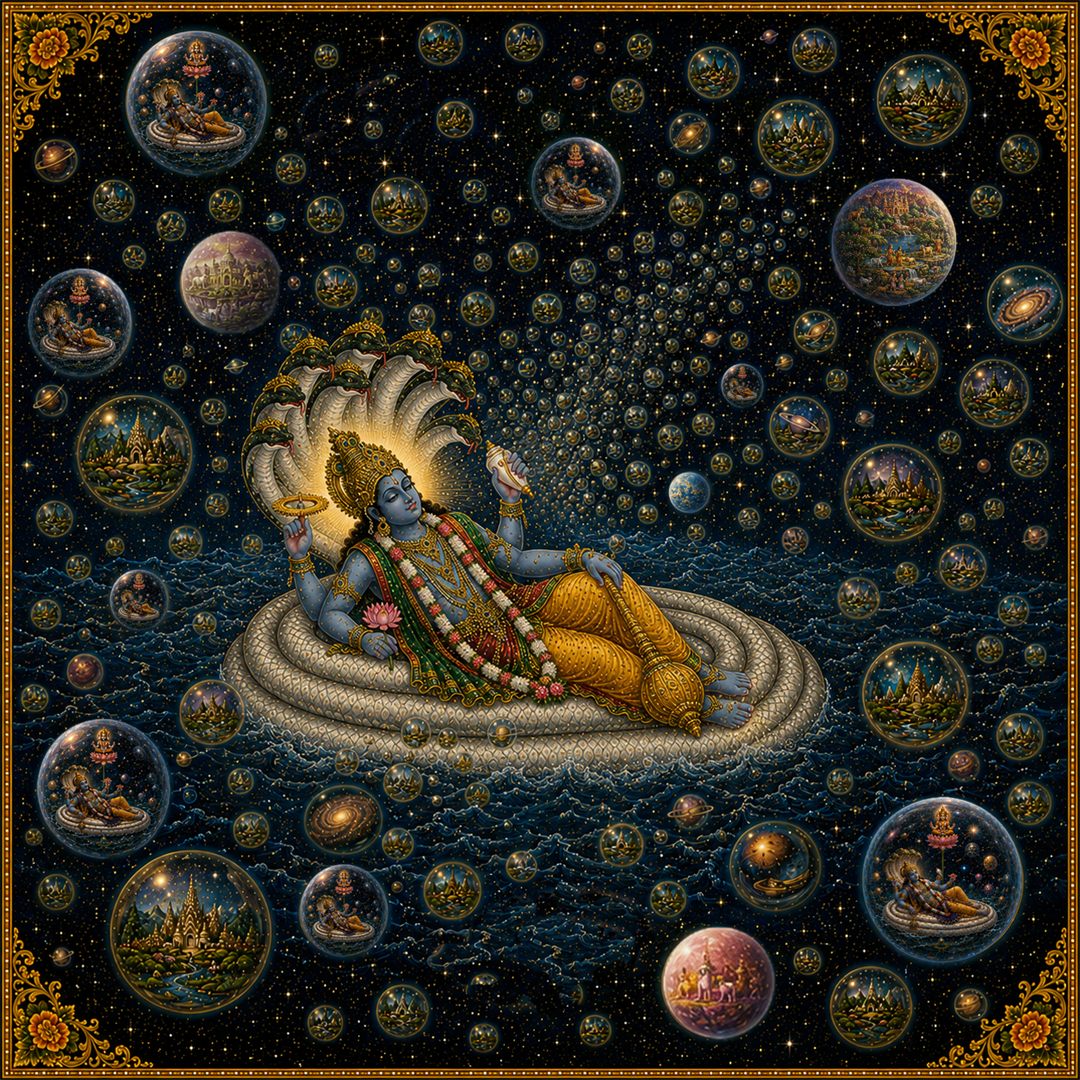
यः कारणार्णवजले भजति स्म योगनिद्रामनन्तजगदण्डसरोमकूपः ।
आधारशक्तिमवलम्ब्य परां स्वमूर्तिं गोविन्दमादिपुरुषं तमहं भजामि ॥ ४७ ॥
yaḥ kāraṇārṇava-jale bhajati sma yoga-
nidrām ananta-jagad-aṇḍa-sa-romakūpaḥ
ādhāra-śaktim avalambya parāṁ sva-mūrtiṁ
govindam ādi-puruṣaṁ tam ahaṁ bhajāmi
I worship Govinda, the primeval Lord, who reclines in yogic slumber upon the waters of the Causal Ocean, with innumerable universes contained in His pores, while resting upon His own supreme form known as Śeṣa, the embodiment of the supporting potency.
yaḥ—who; kāraṇa-arṇava-jale—in the waters of the Causal Ocean; bhajati sma—reclines, enjoys; yoga-nidrām—yogic slumber; ananta-jagad-aṇḍa-sa-romakūpaḥ—whose pores contain innumerable universes; ādhāra-śaktim—the supporting potency; avalambya—taking shelter of, resting upon; parām—supreme, transcendental; sva-mūrtim—His own form; govindam—Govinda; ādi-puruṣam—the primeval Lord; tam—Him; ahaṁ bhajāmi—I worship.
Dig-darśinī-ṭīkā
Śrī Jīva Gosvāmī
Now Brahmā describes Kāraṇārṇavaśāyī Viṣṇu.
The phrase ananta-jagad-aṇḍa-sa-roma-kūpaḥ means: “He whose pores are associated with innumerable universes.” The irregular placement of the particle sa (“with”) after jagad-aṇḍa instead of before it is an archaic usage.
The phrase ādhāra-śaktim avalambya parāṁ sva-mūrtim refers to His supreme form known as Śeṣa, who is constituted of the supporting potency (ādhāra-śakti).
Brahma-saṁhitā-prakāśinī
Śrīla Bhaktivinoda Ṭhākura
Verse 47
I worship that primeval Lord Govinda, who reclines in the Causal Ocean in yogic slumber, with innumerable universes resting within the pores of His body, while taking shelter of His own supreme form known as Śeṣa, who is constituted of the supporting potency (ādhāra-śakti).
(The nature of Ananta, who serves as the couch of Mahā-Viṣṇu, is now being described.)
Ananta, upon whom Mahā-Viṣṇu reclines, is an avatāra of Kṛṣṇa known as Śeṣa, who embodies the principle of being Kṛṣṇa’s servant (dāsa-tattva).
Annotations
Bhakti Gauravani Goswami
Bhaktivinoda Ṭhākura describes Ananta Śeṣa as sei ananta kṛṣṇer dāsa-tattva-rūpa, the embodiment of dāsya-tattva, eternal service to Kṛṣṇa. Kṛṣṇadāsa Kavirāja Gosvāmī says in the Śrī Caitanya-caritāmṛta, Ādi-līlā, Chapter Five, Verse 142: ekale īśvara kṛṣṇa, āra saba bhṛtya. “Lord Kṛṣṇa alone is the īśvara (supreme controller), and all others are His servants!”
A proper understanding of this truth helps the conditioned soul overcome the deeply ingrained false notion that he is the īśvara, a demonic mentality described by Kṛṣṇa in the Bhagavad-gītā (16.14) as the conception īśvaro ‘ham, “I am the lord of everything.”
Even Balarāma, Kṛṣṇa’s first expansion, who is non-different from the Lord, considers Himself Kṛṣṇa’s servant and expands Himself into various forms to serve His brother, as described in the Śrī Caitanya-caritāmṛta (Ādi 5.5, 8-10):
These two [Kṛṣṇa and Balarāma] are one and the same identity. They differ only in form. Lord Balarāma is the first bodily expansion of Kṛṣṇa, and He assists in Lord Kṛṣṇa’s transcendental pastimes.
Lord Balarāma is the original Saṅkarṣaṇa. He assumes five other forms to serve Lord Kṛṣṇa.
He Himself helps in the pastimes of Lord Kṛṣṇa, and He does the work of creation in four other forms.
He executes the orders of Lord Kṛṣṇa in the work of creation, and in the form of Lord Śeṣa He serves Kṛṣṇa in various ways.
Prabhupāda further explains in the purport of Text 10:
According to expert opinion, Balarāma, as the chief of the original quadruple forms, is also the original Saṅkarṣaṇa. Balarāma, the first expansion of Kṛṣṇa, expands Himself in five forms: (1) Mahā-saṅkarṣaṇa, (2) Kāraṇābdhiśāyī, (3) Garbhodakaśāyī, (4) Kṣīrodakaśāyī, and (5) Śeṣa. These five plenary portions are responsible for both the spiritual and material cosmic manifestations. In these five forms Lord Balarāma assists Lord Kṛṣṇa in His activities. The first four of these forms are responsible for the cosmic manifestations, whereas Śeṣa is responsible for personal service to the Lord. Śeṣa is called Ananta, or unlimited, because He assists the Personality of Godhead in His unlimited expansions by performing an unlimited variety of services. Śrī Balarāma is the servitor Godhead who serves Lord Kṛṣṇa in all affairs of existence and knowledge. Lord Nityānanda Prabhu, who is the same servitor Godhead, Balarāma, performs the same service to Lord Gaurāṅga by constant association.
Śrīla Prabhupāda elaborates further in his purport to Śrīmad-Bhāgavatam 5.17.21:
The incarnation of the Supreme Personality of Godhead known as Śeṣa or Ananta has unlimited strength, fame, wealth, knowledge, beauty and renunciation. As described in this verse, Ananta’s strength is so great that the innumerable universes rest on His hoods. He has the bodily features of a snake with thousands of hoods, and since His strength is unlimited, all the universes resting on His hoods feel no heavier than mustard seeds. We can just imagine how insignificant a mustard seed is on the hood of a serpent. In this connection, the reader is referred to Śrī Caitanya-caritāmṛta, Ādi-līlā, Chapter Five, Verses 117-125. There it is stated that Lord Viṣṇu’s incarnation as the serpentine Ananta Śeṣa Nāga supports all the universes on His hoods. By our calculation, a universe may be very, very heavy, but because the Lord is ananta (unlimited), He feels the weight to be no heavier than a mustard seed.
Ananta, or Śeṣa, personifies the principle of dāsya, loving service to the Supreme Lord. Although He is a direct expansion of Kṛṣṇa, His eternal function is to serve Him in every possible way. He becomes the Lord’s couch, throne, umbrella, garments, ornaments, and countless other paraphernalia of divine service. Thus Śeṣa demonstrates that the principle stated by Kṛṣṇadāsa Kavirāja Gosvāmī—“Lord Kṛṣṇa alone is the supreme controller, and all others are His servants!”—extends even to the Lord’s own expansions. Loving devotional service is not merely the constitutional position of the jīva—it is an eternal principle embodied in Śeṣa Himself.