 Spiritual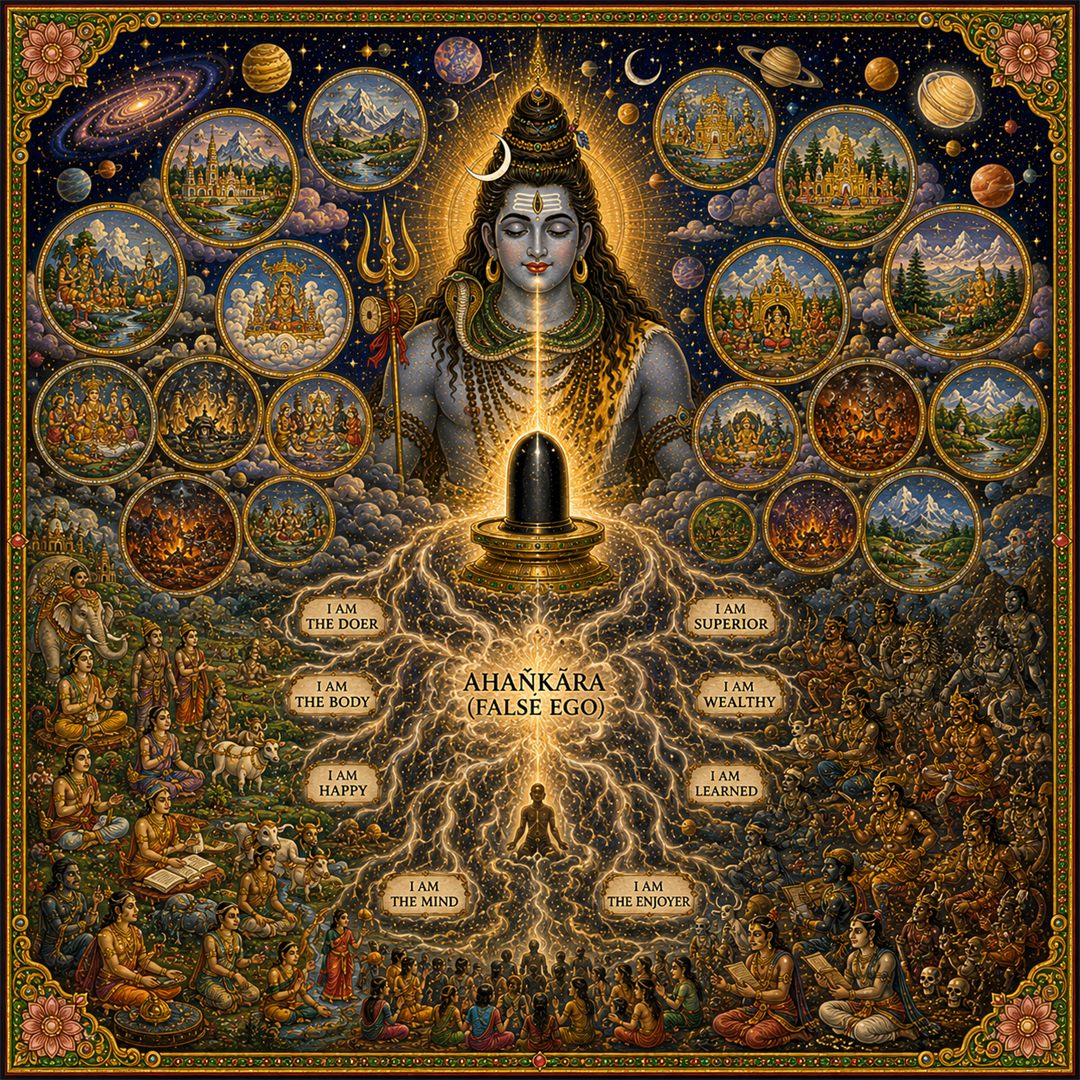
अहङ्कारात्मकं विश्वं तस्मादेतद् व्यजायत ॥ १६ ॥
ahaṅkārātmakaṁ viśvaṁ tasmād etad vyajāyata
This universe, constituted of false ego, arose from him [Śambhu].
ahaṅkāra-ātmakam—constituted of false ego, whose nature is false ego; viśvam—the universe; tasmāt—from him, Śambhu; etat—this; vyajāyata—arose, came into being.
Dig-darśinī-ṭīkā
Jīva Gosvāmī
In this half verse, Brahmā describes another function performed by Śambhu. The entire universe, characterized by false ego, came into existence from him alone. In other words, the universe’s condition of being characterized by false ego arises from Śambhu, because he is the presiding controller of the principle of false ego.
Brahma-saṁhitā-prakāśinī
Bhaktivinoda Ṭhākura
Verse 16
In relation to the living entities, Śambhu’s function is as follows: from him arises the universe constituted of false ego (ahaṅkāra).
In the original spiritual condition, all entities are free from the conception of possessing an existence independent of Bhagavān. The conception of separate, independent existence that appears within the material world, marked by the liṅga as its sign, is a material reflection of pure spiritual existence. This reflected principle appears as the primordial Śambhu and becomes united with Māyā. She is the shadow manifestation of the goddess Ramā and appears as the material yoni, the receptive basis of material manifestation. At that stage Śambhu functions merely as the material principle constituting the aggregate of elemental substance.
Thereafter, when the universes unfold through the progressive evolution of the cosmic elements, the Rudra principle also manifests as a further development of the Śambhu-tattva arising from the region of the brow.
Nevertheless, in every condition Śambhu-tattva remains characterized by ahaṅkāra, the false ego that makes material identification possible.
The innumerable living entities are particles of spiritual consciousness manifest from the rays of the Paramātmā. As long as they identify themselves solely as servants of Bhagavān, they remain entirely free from relation with the material world. In that condition they attain Vaikuṇṭha.
But when they forget that conception and desire to enjoy Māyā, the false-ego principle presided over by Śambhu enters their existence and establishes within them the consciousness of being separate, independent enjoyers. Therefore Śambhu is the root principle underlying both the ego-centered material universe and the living being’s material identification with the body.
Annotations
Bhakti Gauravani Goswami
In modern language, the word “ego” often refers to pride, vanity, or an inflated sense of self-importance. The Sanskrit term ahaṅkāra is broader. It literally means the principle of “I-making” (aham, “I”; kāra, “making”), the construction of a false identity through identifying the self with the external gross body and the internal subtle mind.
In its pure condition the living entity understands, “I am an eternal servant of Kṛṣṇa.” Material identification takes place when that original identity is forgotten and the soul identifies with temporary designations such as body, mind, nationality, race, gender, social position, or religious and spiritual status.
Bhaktivinoda Ṭhākura therefore presents Śambhu as the presiding principle of cosmic individuation. Through ahaṅkāra, the material world is experienced in terms of false identity, possession, and the sense of being “the doer,” with each conditioned being thinking in terms of “I” and “mine.
This does not mean that Śambhu creates the soul itself. Rather, he presides over the mechanism by which the conditioned soul becomes entangled in the conception of an independent existence separate from Bhagavān.
As long as the living entity identifies itself as Kṛṣṇa’s servant, ahaṅkāra has no power over it. When the soul desires independent enjoyment, however, the covering of false ego arises and material existence begins.