 Spiritual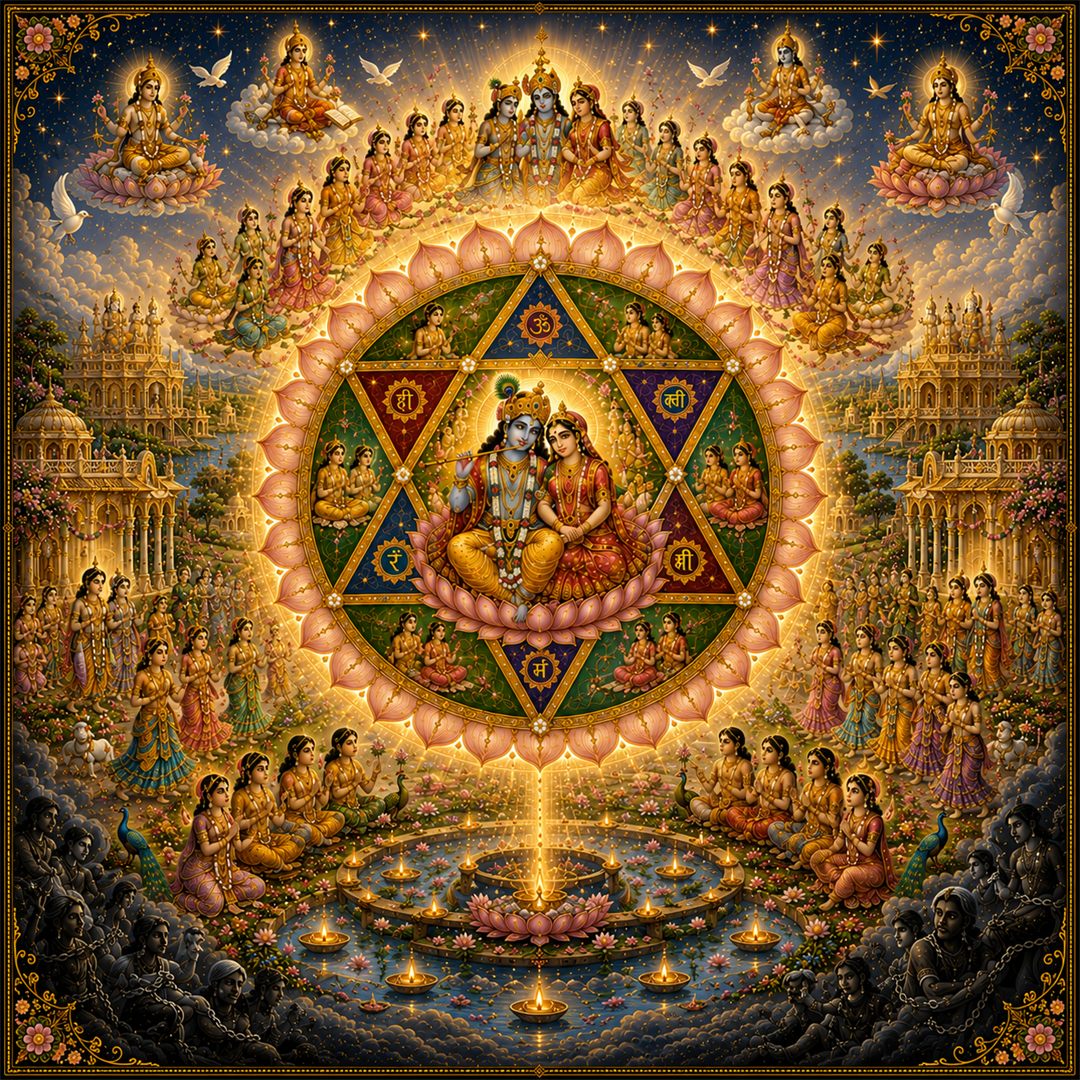
एवं ज्योतिर्मयो देवः सदानन्दः परात्परः ।
आत्मारामस्य तस्यास्ति प्रकृत्या न समागमः ॥ ६ ॥
evaṁ jyotir-mayo devaḥ sad-ānandaḥ parāt paraḥ
ātmārāmasya tasyāsti prakṛtyā na samāgamaḥ
Thus the divine Lord, whose nature is spiritual effulgence, is eternally blissful and supreme beyond the supreme. Since He delights in Himself, He has no contact with material nature.
evam—thus; jyotir-mayaḥ—whose nature is composed of spiritual effulgence; devaḥ—the divine Lord; sad-ānandaḥ—eternally blissful; parāt paraḥ—supreme beyond the supreme; ātma-ārāmasya tasya—of Him who delights in Himself; asti—there is; prakṛtyā—with material nature; na samāgamaḥ—no contact or association.
Dig-darśinī-ṭīkā
Jīva Gosvāmī
Now we proceed to explain the root verse.
Just as the Puruṣa-sūkta and other texts describe the universal form and its indwelling Lord as one puruṣa in order to express their non-difference, so this verse beginning with evam describes Goloka and its presiding Lord as non-different.
The word devaḥ refers to Goloka in the form of its presiding Lord, Śrī Govinda.
The word sad-ānandaḥ indicates His essential nature. The neuter gender is in accordance with the Śruti statement: vijñānam ānandaṁ brahma. “Brahman is knowledge and bliss.”
The word ātmārāmasya means “of Him who delights in Himself,” being independent of anything else.
He has no contact with prakṛti, or māyā, as stated in the Second Canto of the Śrīmad-Bhāgavatam (2.9.10): na yatra māyā kim utāpare. “Māyā does not exist there, what to speak of anything else.”
Brahma-saṁhitā-prakāśinī
Bhaktivinoda Ṭhākura
Verse 6
That Lord of Gokula is the transcendental Supreme Lord, whose very nature is eternal bliss. He is supreme beyond all others and delights in Himself within the transcendental realm of pure consciousness. He has no association with material nature, māyā.
The sole supreme potency (parā-śakti) of Gokuleśvara Śrī Kṛṣṇa, manifest as His spiritual potency (cit-śakti), has brought forth the entire realm of Goloka and all the pastimes enacted there. Only by the mercy of this divine potency can the living entities, who belong to the marginal potency (taṭastha-śakti), enter those eternal pastimes and participate in the bliss of Goloka.
The inferior external potency (māyā-śakti) is merely the shadow of that spiritual potency and remains outside the Virajā River. Virajā lies beyond Brahma-dhāma, the impersonal Brahman effulgence that forms the outer boundary of Mahā-Vaikuṇṭha, which surrounds Goloka.
Within such complete purity, the external māyā-śakti, far from obtaining Kṛṣṇa’s association, is ashamed even to come within the path of His glance.
Annotations
Bhakti Gauravani Gosvāmī
Bhaktivinoda Ṭhākura’s purport presents a graduated structure of transcendental reality, with Goloka as the supreme realm. Surrounding Goloka is Mahā-Vaikuṇṭha, the realm of divine majesty presided over by Nārāyaṇa. Its outer boundary is Brahma-dhāma, the impersonal Brahman effulgence. Beyond Brahma-dhāma flows the Virajā River, which separates the spiritual and material domains, and beyond Virajā lies the realm governed by Māyā, the external energy. This external potency is not an independent principle, but merely the shadow of the internal spiritual potency.
The essential point is that Māyā has absolutely no access to the sac-cid-ānanda reality of Śrī Kṛṣṇa and His abode. She cannot enter Goloka or even come within the path of the Lord’s glance. Bhaktivinoda Ṭhākura expresses this by saying that Māyā feels ashamed even to approach His presence. Thus the distinction between Goloka and the material realm is not merely one of location; they belong to entirely different orders of reality.