 Spiritual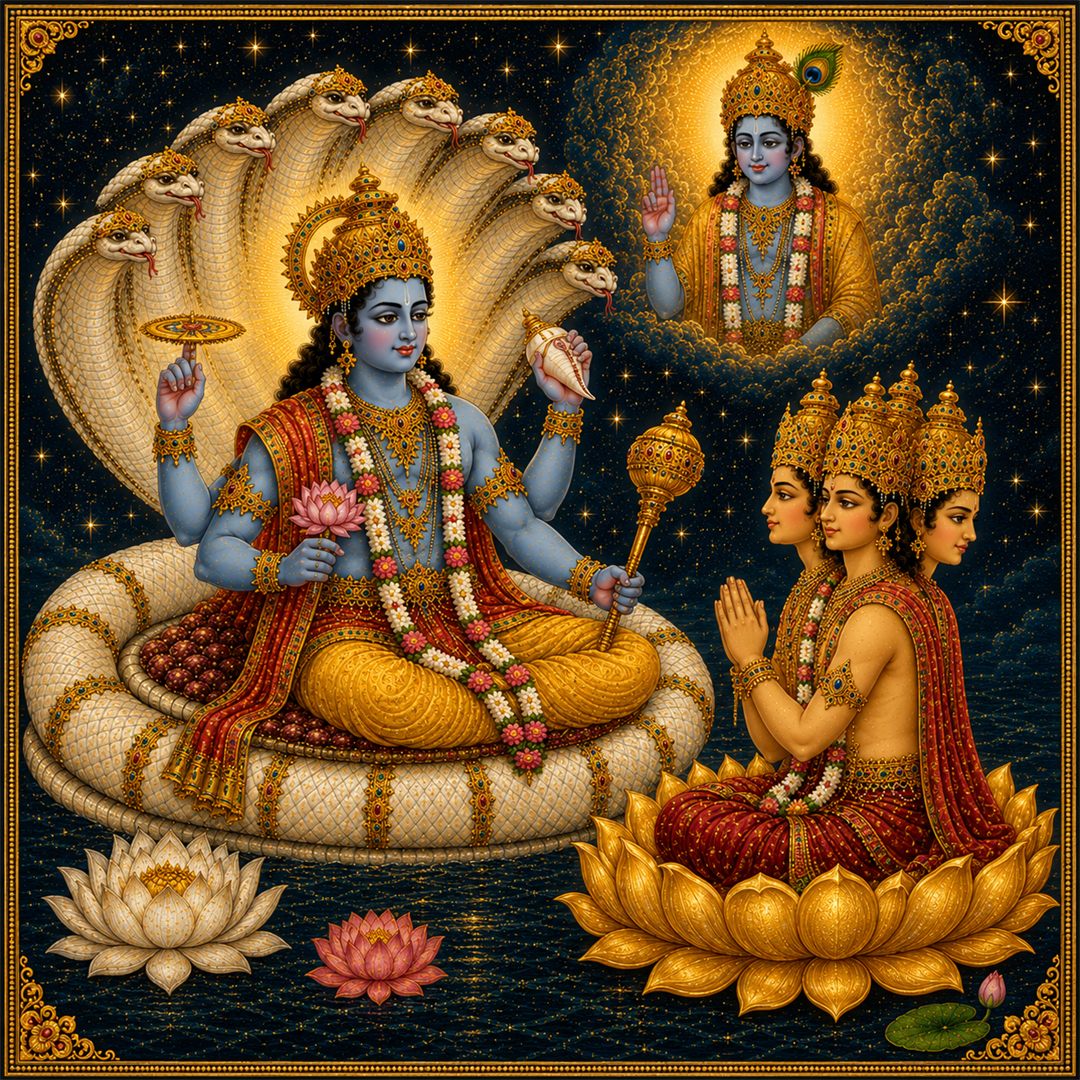
अथोवाच महाविष्णुर्भगवन्तं प्रजापतिम् ।
ब्रह्मन् महत्त्वविज्ञाने प्रजासर्गे च चेन्मतिः ।
पञ्चश्लोकीमिमां विद्यां वत्स दत्तां निबोध मे ॥ ५७ ॥
athovāca mahā-viṣṇur bhagavantaṁ prajāpatiṁ
brahman mahattva-vijñāne prajā-sarge ca cen matiḥ
pañca-ślokīm imāṁ vidyāṁ vatsa dattāṁ nibodha me
Then Mahā-Viṣṇu spoke to the venerable Prajāpati, Brahmā:
“O Brahmā, if your mind is inclined toward knowledge of the Lord’s greatness and toward the creation of living beings, then, My child, understand from Me this knowledge consisting of five verses, which is bestowed by Me.”
atha—then; uvāca—said; mahā-viṣṇuḥ—Mahā-Viṣṇu; bhagavantam prajāpatiṁ—to the venerable Prajāpati, Brahmā; brahman—O Brahmā; mahattva-vijñāne—toward knowledge of the Lord’s greatness; prajā-sarge ca—and toward the creation of living beings; cet matiḥ—if your mind is inclined; pañca-ślokīm—consisting of five verses; imām vidyām—this knowledge; vatsa—My child; dattām—bestowed; nibodha me—understand from Me.
Dig-darśinī-ṭīkā
Śrī Jīva Gosvāmī
Having thus spoken this praise of Him, he [Brahmā] now speaks of his attainment of the Lord’s grace, beginning with the word atha, extending across one and a half verses. Everything here is self-evident.
Brahma-saṁhitā-prakāśinī
Śrīla Bhaktivinoda Ṭhākura
Verse 57
Hearing this profound and essential hymn, Lord Kṛṣṇa said to Brahmā: “O Brahmā, if your mind is inclined toward knowledge of the Lord’s greatness and toward the creation of living beings, then, My dear child, hear from Me this knowledge known as the Five Verses.
When Brahmā, overwhelmed with eagerness, uttered the names Kṛṣṇa and Govinda, which indicate the Lord’s form, qualities, and pastimes, the Supreme Lord became pleased.
Because Brahmā desired to carry out the work of creation, Kṛṣṇa began to explain how conditioned souls may practice pure, exclusive devotional service (viśuddhā ananyā-bhakti) while performing worldly duties in obedience to His command.
Kṛṣṇa said: “Spiritual consciousness itself is true knowledge of the Lord’s greatness. If your mind is inclined toward creating living beings while endowed with that knowledge, then hear these five verses. In these five verses I shall teach the science of devotional service.”
Thus the Lord begins to explain how one may cultivate devotional service while carrying out worldly duties in obedience to His command.
Annotations
Bhakti Gauravani Goswami
How one can remain Kṛṣṇa conscious while fulfilling one’s responsibilities in the world is a recurring question for devotees working within secular society, who often struggle to reconcile their obligations with the practices and regulations of spiritual life.
A similar question was at the heart of Kṛṣṇa’s conversation with Arjuna, who wanted to give up his prescribed duty as a kṣatriya. When Arjuna suggested to leave the battlefield and adopt the life of a renounced mendicant, Kṛṣṇa rejected his proposal. He explained that no one can truly remain inactive, as the modes of material nature force constant activity through body, mind, and senses. Mere external renunciation while the mind remains attached is hypocritical and inferior.
Later in the Bhagavad-gītā (8.7), Kṛṣṇa reveals to Arjuna the secret of success:
tasmāt sarveṣu kāleṣu
mām anusmara yudhya ca
mayy arpita-mano-buddhir
mām evaiṣyasy asaṁśayaḥ
“Therefore, Arjuna, you should always think of Me in the form of Kṛṣṇa and at the same time carry out your prescribed duty of fighting. With your activities dedicated to Me and your mind and intelligence fixed on Me, you will attain Me without doubt.”
In the purport to this verse, Śrīla Prabhupāda presents the solution to this conundrum in a nutshell:
This instruction to Arjuna is very important for all men engaged in material activities. The Lord does not say that one should give up his prescribed duties or engagements. One can continue them and at the same time think of Kṛṣṇa by chanting Hare Kṛṣṇa. This will free one from material contamination and engage the mind and intelligence in Kṛṣṇa. By chanting Kṛṣṇa’s names, one will be transferred to the supreme planet, Kṛṣṇaloka, without a doubt.
Verse 57 marks an important transition in the Brahma-saṁhitā. After revealing His eternal form, abode, associates, and expansions, Govinda now instructs Brahmā in the practical application of bhakti. Brahmā has just received the highest spiritual realization, yet he must now undertake the immense responsibility of creating the material universe. The question therefore arises: How can one remain fully established in pure devotional service while performing extensive worldly duties? The five verses that follow, known as the Pañca-ślokī Vidyā (The Five-Verse Teaching), answer precisely this question. They explain how a devotee may carry out even the greatest material responsibilities as devotional service to the Lord, without becoming entangled in material consciousness.
Rather than advocating renunciation of action, these verses teach the transformation of action through the purification of consciousness. They reveal how work performed in remembrance of Govinda becomes bhakti rather than karma.
***
There is a detail worth noting. Although the text explicitly states that Mahā-Viṣṇu speaks to Brahmā (athovāca mahā-viṣṇur…), Bhaktivinoda Ṭhākura identifies the speaker simply as Kṛṣṇa, thereby underscoring that, from the perspective of tattva, there is no difference between the two. Throughout the Brahma-saṁhitā, Mahā-Viṣṇu, Garbhodakaśāyī Viṣṇu, and Kṣīrodakaśāyī Viṣṇu are described again and again as expansions of Govinda, the original Supreme Personality established in the opening verse (īśvaraḥ paramaḥ kṛṣṇaḥ). For this reason, Bhaktivinoda Ṭhākura attributes directly to Kṛṣṇa the words spoken by Mahā-Viṣṇu, whom Brahmā has just finished repeatedly worshipping in his prayers as govindam ādi-puruṣaṁ —Govinda, the primeval Lord.