 Spiritual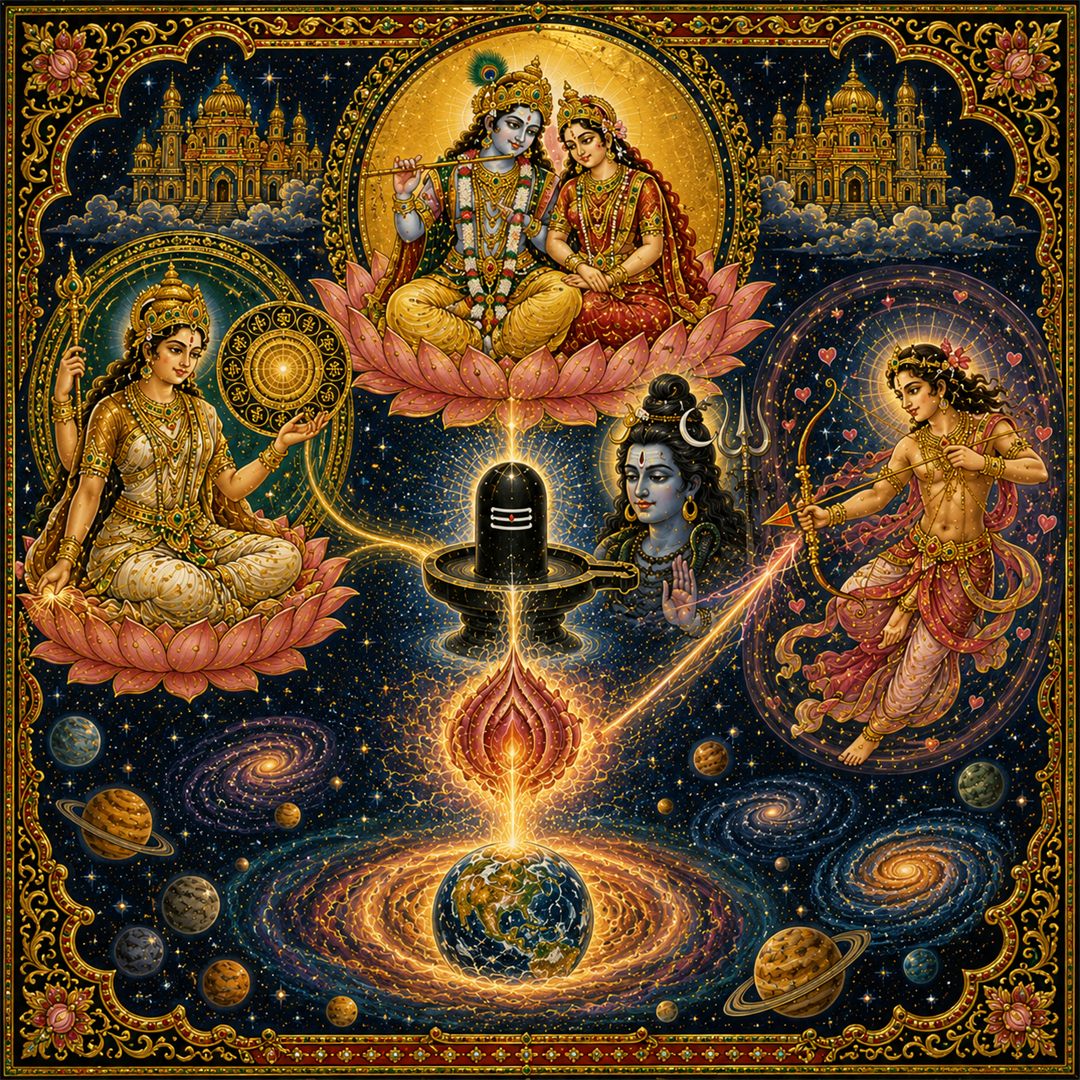
नियतिः सा रमा देवी तत्प्रिया तद्वशं तदा ।
तल्लिङ्गं भगवान् शम्भुर्ज्योतीरूपः सनातनः ॥
या योनिः सापराशक्तिः कामो बीजं महद्धरेः ॥ ८ ॥
niyatiḥ sā ramā devī tat-priyā tad-vaśaṁ tadā
tal-liṅgaṁ bhagavān śambhur jyotī-rūpaḥ sanātanaḥ
yā yoniḥ sāparā-śaktiḥ kāmo bījaṁ mahad dhareḥ
At that time, the goddess Ramā, His beloved, is the principle of divine ordinance and remains under His control. His generative principle, the liṅga, is Bhagavān Śambhu, eternal and of the nature of effulgence. The yoni is the inferior potency, and Hari’s creative desire is the great seed.
niyatiḥ—the principle of divine ordinance; sā—she; ramā devī—the goddess Ramā; tat-priyā—His beloved; tad-vaśam—under His control; tadā—then, at that time; tat-liṅgam—His liṅga, the generative principle corresponding to Him; bhagavān śambhuḥ—Bhagavān Śambhu; jyotī-rūpaḥ—of the nature of effulgence; sanātanaḥ—eternal; yā yoniḥ—that which is the yoni, the generative matrix; sā aparā-śaktiḥ—that is the inferior potency; kāmaḥ—desire, the creative impulse; bījam—the seed; mahat—the great, the mahat-tattva; hareḥ—of Hari.
Dig-darśinī-ṭīkā
Jīva Gosvāmī
One may ask: “Who is this Ramā?”
The text answers in the first half of the verse beginning with niyatiḥ. She is called niyati because she is governed solely by Bhagavān Himself and remains fixed in Him. She is Hari’s inseparable potency. The reason is expressed by the phrase “directly belonging to His own self.” Since His essential nature is consciousness, and since she is non-different from Him, she too is of the nature of consciousness.
Thus it is said in the Twelfth Canto of Śrīmad-Bhāgavatam (12.11.20): anapāyinī bhagavatī śaktiḥ śrīḥ sākṣād ātmanaḥ hareḥ. “The goddess of fortune, Śrī, who never leaves the Lord’s side, appears with Him in this world as the representation of His internal potency.”
And the commentary explains: “She is the inseparable potency of Hari because She directly belongs to His essence. Since His nature is consciousness, and since She is non-different from Him, She too is of the nature of consciousness.”
By the use of the word sākṣāt, it is implied that this does not refer to Māyā, of whom Brahmā said in the Śrīmad-Bhāgavatam (2.5.13): vilajjamānayā yasya sthātum īkṣā-pathe ‘muyā. “That Māyā, being ashamed, cannot remain within the range of His glance.”
Her status as an inseparable potency is also described in the Viṣṇu Purāṇa:
nityaiva sā jagan-mātā viṣṇoḥ śrīr anapāyinī
yathā sarva-gato viṣṇus tathaiveyaṁ dvijottama
“She, the mother of the universe, is eternally the inseparable Śrī of Viṣṇu. O best of brāhmaṇas, just as Viṣṇu is all-pervading, so is She.”
And further:
evaṁ yathā jagat-svāmī deva-devo janārdanaḥ |
avatāraṁ karoty eṣā tathā śrīs tat-sahāyinī ||
“Just as Janārdana, the Lord of the universe and God of gods, descends, so Śrī also appears as His companion.”
One may object: “Are not Śiva and Śakti sometimes described as the causes of creation?”
In reply, as in descriptions of the virāṭ, the text figuratively presents them as particular limbs or aspects of Him. Thus it says: tal-liṅgaṁ bhagavān śambhuḥ. “That liṅga is Bhagavān Śambhu.”
According to the statement of the Viṣṇu Purāṇa: tasyā yutā yutāṁśāṁśe viśva-śaktir iyaṁ sthitā. “This universal potency abides within an exceedingly minute fraction of Him.”
The Puruṣa, who is the self of the material manifestation and a great expansion of Bhagavān, possesses an unmanifest form because He is covered by the effulgence of His own portion. The portion of that Puruṣa which occupies the position of the liṅga and produces the material universe is Śambhu. Other manifestations bear the name Śambhu because they are particular manifestations of this principle. This will later (Verse 45) be explained by the example: kṣīraṁ yathā dadhi-vikāra-viśeṣa-yogāt. “Just as milk becomes transformed into yogurt…”
Similarly, that portion of Māyā in her unmanifest condition which occupies the position of the yoni is the inferior potency known as pradhāna. Within her arises the desire of Hari; in other words, the portion of Hari known as the Puruṣa desires to bring forth the creation. Thereafter the seed in the form of the mahat-tattva, containing the living entities and the entire material cosmos, is implanted. Thus the Śruti states: so ‘kāmayata. “He desired.” And in the Third Canto it is said: kāla-vṛttyā. “Through the agency of time.”
Brahma-saṁhitā-prakāśinī
Bhaktivinoda Ṭhākura
Verse 8
(The process of that indirect association with Māyā is now being described.)
Goddess Ramā, the spiritual potency (cit-śakti), is Bhagavān’s beloved and the principle of divine ordinance (niyati), remaining entirely under His control. At the time of creation, when Kṛṣṇa’s expansion becomes inclined toward manifesting the material world, the effulgence arising from His personal expansion appears as the divine liṅga, Bhagavān Śambhu, a particular reflected manifestation of the eternal effulgence.
That liṅga is the principle destined to generate the material world and acts under divine ordinance. The corresponding generative matrix is the inferior potency, Māyā in the form of the yoni. Through their conjunction, the reflected kāma-bīja of Hari arises in the form of the mahat-tattva.
Saṅkarṣaṇa, endowed with the desire for creation, is the expansion of Kṛṣṇa inclined toward generating the material world. Reclining in the waters of the Causal Ocean as the original avatāra-puruṣa, He casts His glance upon Māyā. That glance is the instrumental cause of creation.
The reflected appearance of His effulgence is the Śambhu-liṅga, and that becomes united within the generative matrix of Māyā, who is the shadow of the Ramā-śakti. At that time, the reflected appearance of the kāma-bīja in the form of the mahat-tattva arises and becomes engaged in the work of creation.
The initial manifestation produced by Mahā-Viṣṇu’s creative desire is called the golden mahat-tattva; it is the principle of the cosmic mind inclined toward creation.
The deeper purport is that the will of the Puruṣa creates through both the instrumental and material causal principles. Māyā, represented as the yoni, is the instrumental matrix, while Śambhu, represented as the liṅga, embodies the material causal principle. Mahā-Viṣṇu, the Puruṣa, is the conscious agent whose will brings them into union.
Pradhāna, the primordial material substance, constitutes the material causal principle, while prakṛti, the supporting matrix, is Māyā. The conscious will that brings these together is the Puruṣa, the expansion of Śrī Kṛṣṇa who manifests the material universe. These three together constitute the agency of material creation.
The kāma-bīja existing in Goloka is completely pure and spiritual, whereas the kāma-bīja existing in the material world belongs to the shadow potency connected with time and other forces. The first-mentioned kāma-bīja, although serving as the original prototype of the reflected manifestation found within Māyā, remains infinitely remote from her, whereas the second kāma-bīja is merely a material reflection.
How Śambhu comes into existence is described later, in Verses 10 and 15.
Annotations
Bhakti Gauravani Goswami
The terms liṅga and yoni in this passage refer to primordial metaphysical principles involved in the creation of the universe. Although these words today are associated primarily with the male and female generative organs, their original Sanskrit meanings are broader and, in this context, philosophical.
Liṅga literally means “mark,” “sign,” or “manifesting symbol.” In this context it refers to the projecting or generative principle represented by Śambhu. The liṅga symbolizes the active, formative impulse through which latent material nature becomes capable of manifestation.
Yoni literally means “source,” “womb,” “matrix,” or “place of generation.” Here it refers to māyā-prakṛti, material nature, as the receptive and generative matrix from which the material universe emerges.
The imagery employed in these verses intentionally parallels biological generation, because the familiar language of generation provides an analogy for the causal principles involved in cosmic manifestation. The union of liṅga and yoni therefore represents the interaction of the activating principle, the receptive matrix, and the divine will by which creation becomes manifest.
The text repeatedly emphasizes, however, that this process involves no direct material contact between the Supreme Lord and Māyā. The Lord remains completely transcendental. Material nature is activated only indirectly through the Puruṣa-avatāra, through the mediation of the spiritual potency Ramā, and through the operation of the time potency (kāla-śakti).
For this reason, the ācāryas carefully distinguish between the pure transcendental kāma-bīja eternally present in Goloka and its reflected, shadow-like manifestation within material creation. Material generation is a distant reflection of a higher causal pattern, but the original spiritual kāma-bīja must never be understood as mundane sexuality projected onto the Supreme Lord.
The same danger of material projection applies to the amorous pastimes of Rādhā and Kṛṣṇa, which can easily be misconstrued as being of the same nature as the sexual relationships of mundane lovers.
In a lecture given on August 27, 1969, in Hamburg, Śrīla Prabhupāda explained the difference to his young followers:
By our present senses, we cannot understand what is Kṛṣṇa, God, what is His name, what is His form, what are His qualities. Therefore, if we try to understand Kṛṣṇa by looking at His picture, “Oh, Kṛṣṇa is embracing Rādhārāṇī or the gopīs,” we shall come to a wrong understanding. Because unless our senses are purified, we shall view Kṛṣṇa and Rādhārāṇī as an ordinary young boy and girl and their dealings as ordinary love affairs. But actually their relationship is not like this. It is pure.
The author of the Caitanya-caritāmṛta has explained that there is a gulf of difference between the loving affairs of the gopīs with Kṛṣṇa and the ordinary, lustful dealings of human beings. He compares that the gopīs’ love for Kṛṣṇa is gold, and our so-called love here is iron. As there is a difference between gold and iron, similarly there is a difference between the loving affairs of the gopīs with Kṛṣṇa and the lusty affairs between boys and girls. It is never equal.
Therefore it is said: ataḥ śrī-kṛṣṇa-nāmādi na bhaved grāhyam indriyaiḥ. Our present senses, these impure, contaminated senses cannot understand Kṛṣṇa; therefore we should follow this principle: sevonmukhe hi jihvādau. First of all, engage in chanting Hare Kṛṣṇa. There is Rādhā and Kṛṣṇa. Harā is Rādhā, and there is Kṛṣṇa. But don’t try to understand by your present senses, but simply chant Their holy names: Hare Kṛṣṇa. Then ceto-darpaṇa-mārjanam. When the dust on the mirror of your heart will be cleansed, and there will be no more material condition, then you will be able to understand.
Vaiṣṇava philosophy is a profound science and must be studied carefully if intricate subjects such as those discussed in the present verse are to be properly understood. Otherwise, we risk projecting our material conceptions onto transcendental reality and thereby misunderstanding its true nature.