 Spiritual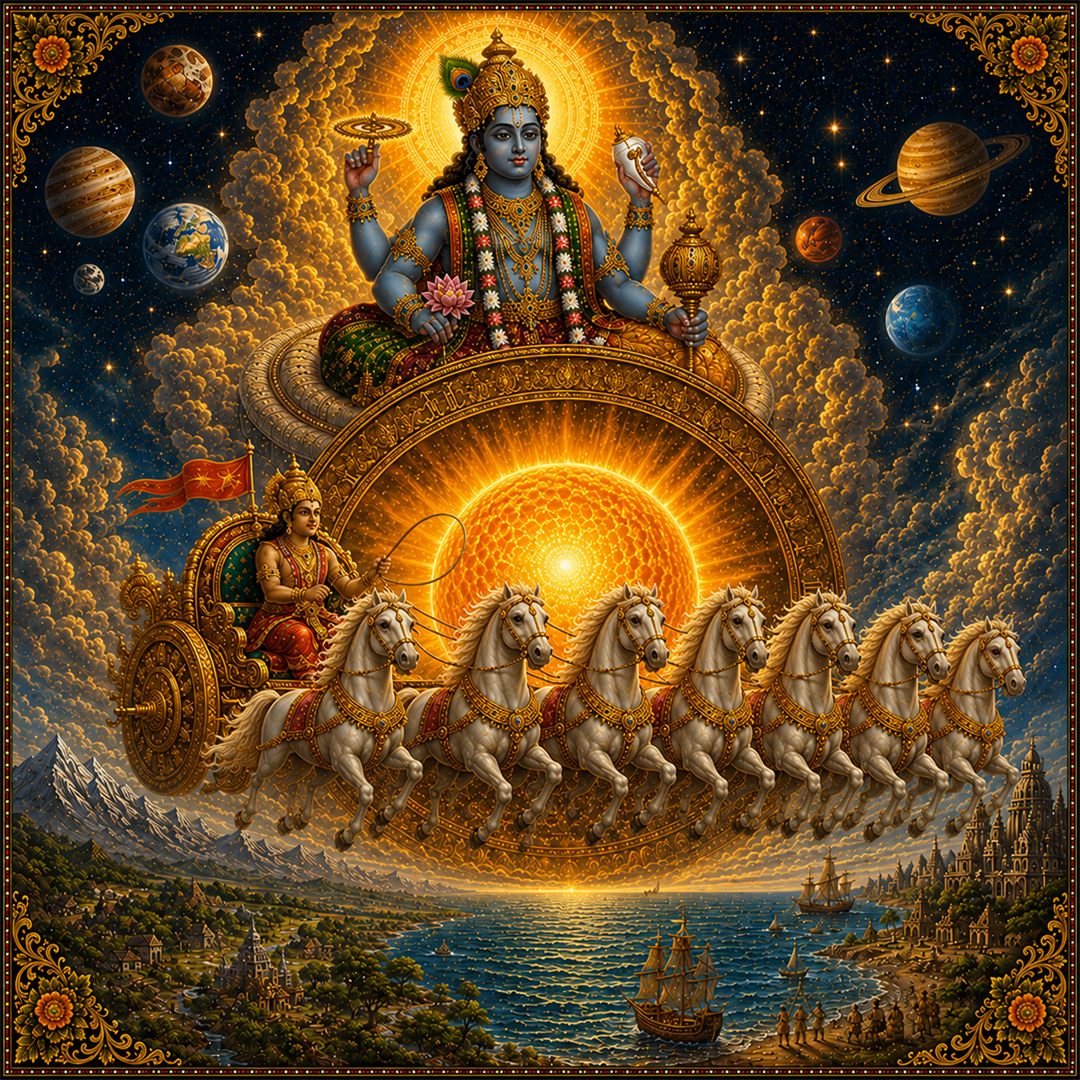
यच्चक्षुरेष सविता सकलग्रहाणां राजा समस्तसुरमूर्तिरशेषतेजाः ।
यस्याज्ञया भ्रमति सम्भृतकालचक्रो गोविन्दमादिपुरुषं तमहं भजामि ॥ ५२ ॥
yac-cakṣur eṣa savitā sakala-grahāṇāṁ
rājā samasta-sura-mūrtir aśeṣa-tejāḥ
yasyājñayā bhramati sambhṛta-kāla-cakro
govindam ādi-puruṣaṁ tam ahaṁ bhajāmi
I worship Govinda, the primeval Lord, whose eye is the Sun, the king of all the planets, the embodiment of all the demigods, and endowed with unlimited brilliance. By His command the Sun moves within the wheel of time.
yat-cakṣuḥ—whose eye; eṣaḥ savitā—this Sun; sakala-grahāṇām rājā—the king of all the planets; samasta-sura-mūrtiḥ—the embodiment of all the demigods; aśeṣa-tejāḥ—possessing unlimited brilliance; yasya ājñayā—by whose command; bhramati—moves; sambhṛta-kāla-cakraḥ—bearing the wheel of time; govindam—Govinda; ādi-puruṣam—the primeval Lord; tam—Him; ahaṁ bhajāmi—I worship.
Dig-darśinī-ṭīkā
Śrī Jīva Gosvāmī
Someone may object that some authorities regard the Sun-god as the Supreme Lord. Brahmā answers this objection with the words yac-cakṣur.... The Sun is not the Supreme Lord Himself but the eye of Govinda, for by illuminating the universe it serves as His eye.
This is confirmed by Kṛṣṇa in the Bhagavad-gītā (15.12): “The splendor that is found in the Sun, that illumines the entire world, and also that which is in the Moon and in fire—know that splendor to be Mine.”
The Upaniṣads likewise declare: “Out of fear of Him the wind blows; out of fear of Him the sun rises.” Moreover, within the universal form (virāṭ-rūpa), the Sun is described as the eye of the Lord.
Brahma-saṁhitā-prakāśinī
Śrīla Bhaktivinoda Ṭhākura
Verse 52
I worship that primeval Lord Govinda, by whose command Savitā, the Sun—the king of all the planets, possessed of unlimited splendor, the embodiment of all the demigods, and the eye of the world—travels mounted upon the wheel of time.
Many followers of the Vedas worship the Sun as Brahman. The Sun is one of the five principal demigods (pañca-devatā).
Some maintain that heat is the generative principle and that the Sun alone is the reservoir of heat and thus the cause of the universe.
Whatever may be said, the Sun is the presiding deity of a sphere composed of material light. Therefore he is an administrative demigod (ādhikārika-devatā).
It is only by the command of Govinda that the Sun performs his service.
Annotations
Bhakti Gauravani Goswami
Throughout history, the Sun has been one of the most widely worshiped objects in human civilization. Ancient peoples recognized that without the Sun there would be no light, heat, agriculture, seasons, or biological life. As a result, many cultures regarded the Sun as the supreme deity or as the visible manifestation of divine power. Solar worship appeared in ancient Egypt, Greece, Rome, Japan, and throughout the civilizations of the Americas.
The Vedic tradition also accords the Sun an exalted position. The sun-god (Sūrya or Savitā) is honored as one of the principal demigods and as the source of light, heat, and the basis for measuring time within the universe. The great Solar Dynasty (Sūrya-vaṁśa), in which Lord Rāmacandra appeared, traces its lineage to the sun-god.
Yet Brahmā’s purpose in this verse is to establish that however glorious the Sun may be, he is not the Supreme Being. The Sun is described as the eye of the universal form and as the king of the planets, but he moves only according to Govinda’s command. His brilliance is a manifestation of the Lord’s power, and his orbit is governed by the wheel of time established by the Supreme Personality of Godhead. Thus the verse acknowledges the Sun’s extraordinary importance while placing him in his proper relationship to Govinda, the source of the universal order.
In the Tenth Canto of Śrīmad-Bhāgavatam (10.87.41), the Śrutis, the personified Vedas, extend this vision beyond the Sun and its cosmic course. They declare that the innumerable universes, each enclosed within its own coverings, move within the Supreme Lord under the influence of time, like particles of dust blown about in the sky: antarāṇḍa-nicayā nanu sāvaraṇāḥ kha iva rajāṁsi vānti vayasā saha. Thus, the kāla-cakra of this verse is not confined to the solar orbit or to the calculation of days, seasons, and years. It is the divinely ordered power by which all material bodies, planets, and universes move, change, and endure for their appointed duration, while Govinda Himself remains untouched by its influence. He is always fully independent, sva-rāt, as stated in the first verse of the Śrīmad-Bhāgavatam.