 Spiritual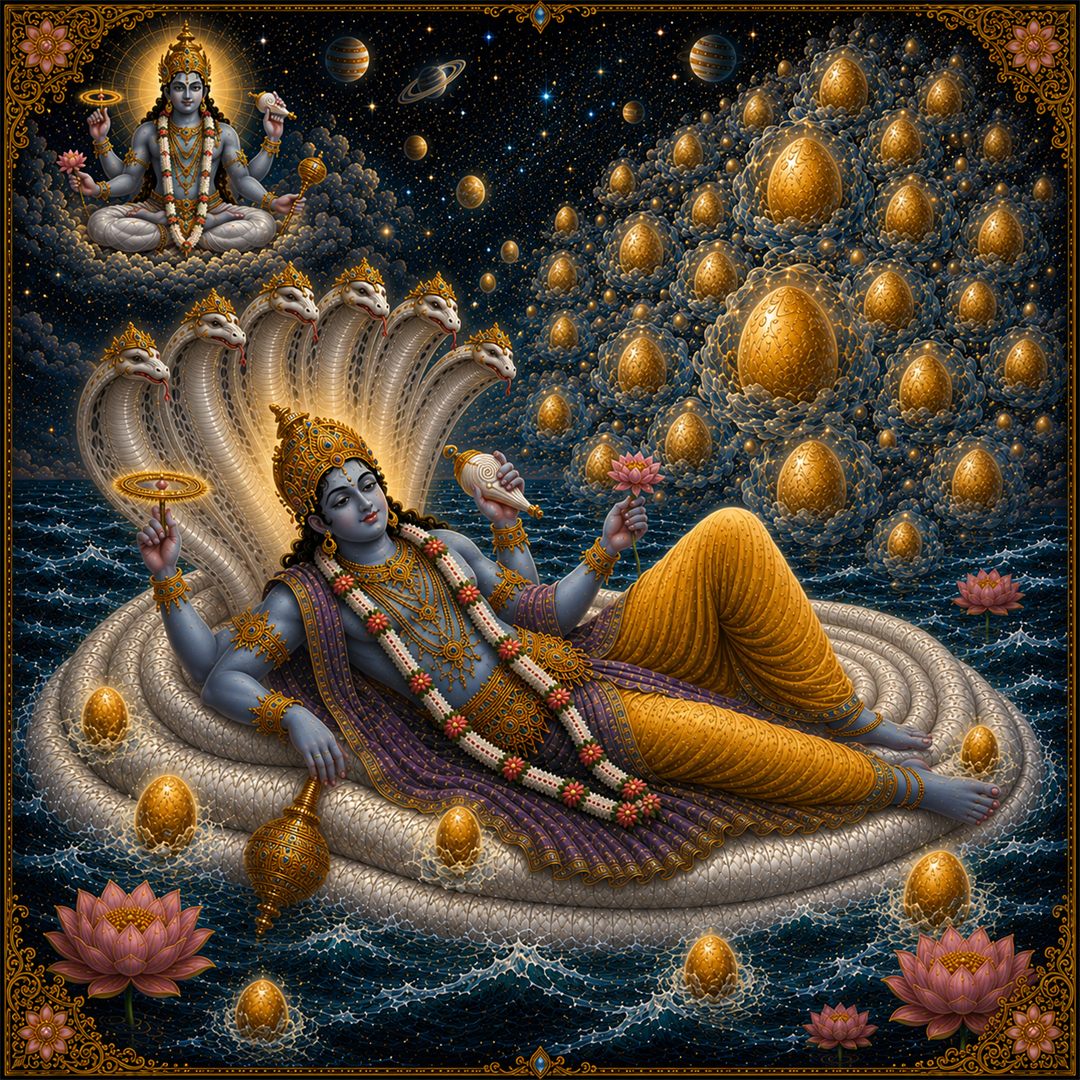
तद्रोमबिलजालेषु बीजं सङ्कर्षणस्य च ।
हैमाण्यण्डानि जातानि महाभूतावृतानि तु ॥ १३ ॥
tad-roma-bila-jāleṣu bījaṁ saṅkarṣaṇasya ca
haimāny aṇḍāni jātāni mahā-bhūtāvṛtāni tu
Within the network of His hair pores, golden cosmic eggs enveloped by the great elements arose from the seed of Saṅkarṣaṇa.
tat—of Him, Mahā-Viṣṇu; roma-bila-jāleṣu—within the network of His hair pores; bījam—the seed; saṅkarṣaṇasya—of Saṅkarṣaṇa; ca—and; haimāni—golden; aṇḍāni—cosmic eggs, universes; jātāni—arose, came into being; mahā-bhūta-āvṛtāni—enveloped by the great elements; tu—indeed.
Dig-darśinī-ṭīkā
Jīva Gosvāmī
Brahmā now describes the origin of the universes from that same Lord in the verse beginning with tad-roma. The word tat means “of Him.” The seed of that Lord, who is of the nature of Saṅkarṣaṇa, had previously been placed within the yoni-śakti, the womb potency. Having developed to the stage of the subtle elements, it then entered the cavities within the network of His hair pores and became golden cosmic eggs. Those eggs were enveloped by portions of the great elements that had not yet undergone quintuplication.
In this regard, Brahmā says in the Śrīmad-Bhāgavatam (10.14.11):
kvedṛg-vidhāviganitāṇḍa-parāṇu-caryā
vātādhva-roma-vivarasya ca te mahitvam
“What can be said of Your greatness, when countless universes move like atoms through the pores of Your body along the pathways of the wind?”
And in the Third Canto (SB 3.11.40–41) Maitreya says:
vikāraiḥ sahito yuktair viśeṣādibhir āvṛtaḥ
aṇḍa-koṣo bahir ayaṁ pañcāśat-koṭi-vistṛtaḥ
daśottarādhikair yatra praviṣṭaḥ paramāṇu-vat
lakṣyate ‘ntar-gatāś cānye koṭiśo hy aṇḍa-rāśayaḥ
“Together with its transformations and enclosed by the elements beginning with earth, this universal shell extends five hundred million yojanas. Surrounded by successive coverings, each ten times greater than the previous one, it appears like an atom. Millions of other clusters of universes are also situated within the vast material aggregate.”
Brahma-saṁhitā-prakāśinī
Bhaktivinoda Ṭhākura
Verse 13
Within the pores of Mahā-Viṣṇu, the spiritual seed of Saṅkarṣaṇa gives rise to innumerable golden cosmic eggs. Those golden universes are enveloped by the mahā-bhūtas, the great material elements.
The original Puruṣa-avatāra, reclining within the Causal Ocean, manifests innumerable seeds of universes within the pores of His body. These clusters of universes are imitations of the infinite abodes of the spiritual world. While they remain within the body of the Puruṣa-avatāra, they exist like golden luminous eggs possessing only a semblance of spiritual existence.
According to Mahā-Viṣṇu’s will concerning the universes, the subtle elements associated with Māyā’s instrumental and material causal functions already surround the cosmic eggs as coverings.
Then, emerging with the exhalation of the Puruṣa, those golden cosmic eggs enter the limitless chambers of Māyā. There they expand further through the agency of the uncombined material elements (apañcīkṛta-bhūtas).
Annotations
Bhakti Gauravani Goswami
The “golden cosmic egg” in this verse represents the embryonic state of each universe before fully developed material differentiation takes place.
Bhaktivinoda Ṭhākura introduces a subtle philosophical point here: the universes initially exist in a luminous condition resembling a reflection of the spiritual world. They are not yet gross material structures. Even before they emerge from Mahā-Viṣṇu, they are already surrounded by subtle elemental coverings. After His exhalation carries them into the domain of Māyā, the uncombined elements expand further and the gross material manifestation gradually develops. Thus the spiritual seed gives rise to luminous cosmic embryos already enclosed by subtle elemental coverings. Those coverings later expand into the gross material structure of each universe.
The material cosmos is therefore not independent of the Supreme Lord but exists as a distant reflected imitation of eternal spiritual reality.
In the Bhagavad-gītā (15.1), Kṛṣṇa compares the material world to an upside-down banyan tree. Śrīla Prabhupāda explains in his purport:
The tree of this material world is only a reflection of the real tree of the spiritual world. This reflection of the spiritual world is situated on desire, just as a tree’s reflection is situated on water. Desire is the cause of things’ being situated in this reflected material light. One who wants to get out of this material existence must know this tree thoroughly through analytical study. Then he can cut off his relationship with it.
Bhaktivinoda Ṭhākura mentions that the golden universes, after entering the domain of Māyā, are expanded by the apañcīkṛta elements. This term, which literally means “not yet made fivefold,” belongs to the technical vocabulary of classical Vedānta and deserves a brief explanation, since it does not appear in Prabhupāda’s books.
According to the Vedāntic doctrine of pañcīkaraṇa (“quintuplication”), the five elements first exist in a subtle, unmixed state called apañcīkṛta. To produce the gross elements, each subtle element is divided into two. One half retains its original identity, while the other half is divided into four equal parts and combined with one-eighth of each of the other four elements. Gross earth, for example, consists of one-half subtle earth and one-eighth each of water, fire, air, and ether. For this reason, every gross element is composite.
Prabhupāda presents the same essential idea using the Bhāgavatam’s own vocabulary: the subtle sense objects (tan-mātras) give rise to the gross elements, and each successive element possesses the qualities of those preceding it. This account likewise shows that gross matter is internally composite, although it describes the process differently from the technical doctrine of pañcīkaraṇa.
Bhaktivinoda Ṭhākura, writing for readers familiar with traditional Vedānta terminology, uses a technical expression they would readily have understood. In summary, the cosmic eggs, upon entering Māyā’s realm, are still surrounded by matter in its subtle, uncombined state, because the full gross manifestation, described in the following verses, has not yet taken place.