 Spiritual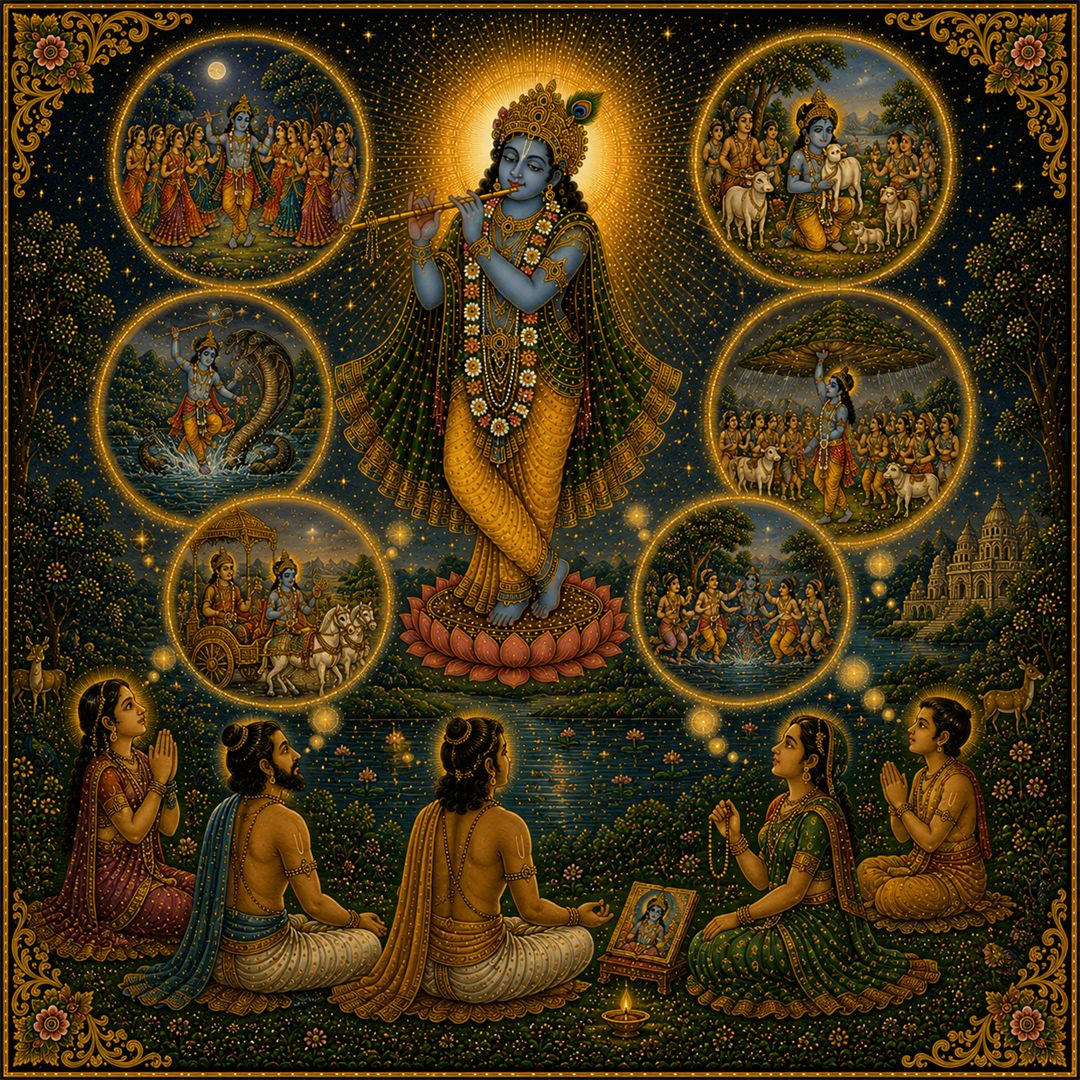
आनन्दचिन्मयरसात्मकतया मनःसु यः प्राणिनां प्रतिफलन्स्मरतामुपेत्य । लीलायितेन भुवनानि जयत्यजस्रं गोविन्दमादिपुरुषं तमहं भजामि ॥ ४२ ॥
ānanda-cinmaya-rasātmatayā manaḥsu
yaḥ prāṇināṁ pratiphalan smaratām upetya
līlāyitena bhuvanāni jayaty ajasraṁ
govindam ādi-puruṣaṁ tam ahaṁ bhajāmi
I worship Govinda, the primeval Lord, who, entering the minds of those living beings who remember Him, is reflected there as the embodiment of blissful spiritual rasa and continually conquers the worlds through His playful acts.
ānanda-cinmaya-rasa-ātmatayā—as the embodiment of blissful spiritual rasa; manaḥsu—within the minds; yaḥ—who; prāṇinām—of living beings; pratiphalan—being reflected; smaratām—of those who remember Him; upetya—entering, approaching; līlāyitena—by His playful activity; bhuvanāni—the worlds; jayati—conquers; ajasram—continuously; govindam—Govinda; ādi-puruṣam—the primeval Lord; tam—Him; ahaṁ bhajāmi—I worship.
Dig-darśinī-ṭīkā
Śrī Jīva Gosvāmī
Now Brahmā describes Govinda’s power to enchant those who are absorbed in Him. Thus the verse begins with ānanda-cinmaya-rasa.
This ānanda-cinmaya-rasa is the rasa of ecstatic love (prema-rasa) known as ujjvala-rasa. By becoming the very embodiment of that rasa, or, in other words, by being embraced by it, Govinda is reflected within the minds of living beings.
Although He arises there only slightly, He appears as the reflection of an atomic particle touched by an aspect of His all-enchanting potency, and thus He enters those who remember Him. The words smaratām upetya should be connected in this way.
Concerning this it is said in the five chapters describing the rāsa-līlā (SB 10.32.2): sākṣān manmatha-manmathaḥ.“ He directly enchants Cupid himself.” Just as the Scriptures speak of cakṣuṣaś cakṣuḥ, “the eye of the eye,” so Kṛṣṇa is the Cupid of Cupid. Thus, although He is the cause of Smara1, His being seen as touched by the influence of Smara is nevertheless observed, just as His entering the universe is also observed.2
Brahma-saṁhitā-prakāśinī
Śrīla Bhaktivinoda Ṭhākura
Verse 42
I worship that primeval Lord Govinda, who, as the very embodiment of blissful conscious rasa (ānanda-cinmaya-rasa), is reflected within the minds of those living beings who remember Him, and who, through the playful activities of His divine pastimes, continually conquers all the worlds.
The rememberers referred to here are those who, following proper spiritual instruction, constantly remember the names, form, qualities, and pastimes connected with Kṛṣṇa’s form as Manmatha-manmatha3 in ujjvala-rasa. It is within their hearts that Kṛṣṇa, together with His abode and pastimes, manifests Himself.
The abode and pastimes of Kṛṣṇa that thus appear within the heart completely conquer all the majesty and beauty found within the material world.
Annotations
Bhakti Gauravani Goswami
This verse emphasizes the practice of smaraṇam, remembrance of Kṛṣṇa. In the Bhagavad-gītā (8.5-6), Kṛṣṇa says that those who remember Him at the time of death will surely come to Him. In the purport to Verse 5, Śrīla Prabhupāda speaks about the importance of smaranam:
The word smaran (remembering) is important. Remembrance of Kṛṣṇa is not possible for the impure soul who has not practiced Kṛṣṇa consciousness in devotional service. Therefore one should practice Kṛṣṇa consciousness from the very beginning of life. If one wants to achieve success at the end of his life, the process of remembering Kṛṣṇa is essential. Therefore one should constantly, incessantly chant the mahā-mantra: Hare Kṛṣṇa, Hare Kṛṣṇa, Kṛṣṇa Kṛṣṇa, Hare Hare Hare Rāma, Hare Rāma, Rāma Rāma, Hare Hare.
In the purport to the next verse, he repeats the same instruction:
One’s thoughts during the course of one’s life accumulate to influence one’s thoughts at the moment of death, so this life creates one’s next life. If in one’s present life one lives in the mode of goodness and always thinks of Kṛṣṇa, it is possible for one to remember Kṛṣṇa at the end of one’s life. That will help one be transferred to the transcendental nature of Kṛṣṇa. If one is transcendentally absorbed in Kṛṣṇa’s service, then his next body will be transcendental (spiritual), not material. Therefore the chanting of Hare Kṛṣṇa, Hare Kṛṣṇa, Kṛṣṇa Kṛṣṇa, Hare Hare/ Hare Rāma, Hare Rāma, Rāma Rāma, Hare Hare is the best process for successfully changing one’s state of being at the end of one’s life.
Bhaktivinoda Ṭhākura therefore identifies the true rememberers as those who constantly meditate on Kṛṣṇa’s names, form, qualities, and pastimes according to authentic spiritual instruction. As remembrance deepens, the Lord’s form, abode, associates, and pastimes become progressively revealed within the heart. What begins as faith gradually develops into realization.
The verse also explains why Kṛṣṇa is called Manmatha-manmatha, “the enchanter of Cupid.” Ordinary attraction captivates the mind and binds it to the material world. Kṛṣṇa’s beauty, however, attracts the soul toward spiritual reality. Thus even a slight reflection of His beauty and sweetness within the heart surpasses all the attractions of the material world.
The phrase bhuvanāni jayati, “He conquers all the worlds,” should therefore be understood in this context. Kṛṣṇa does not conquer by force but by attraction. Through the beauty of His form, the sweetness of His flute, the charm of His pastimes, and the power of His love, He conquers the hearts of living beings throughout all worlds.