 Spiritual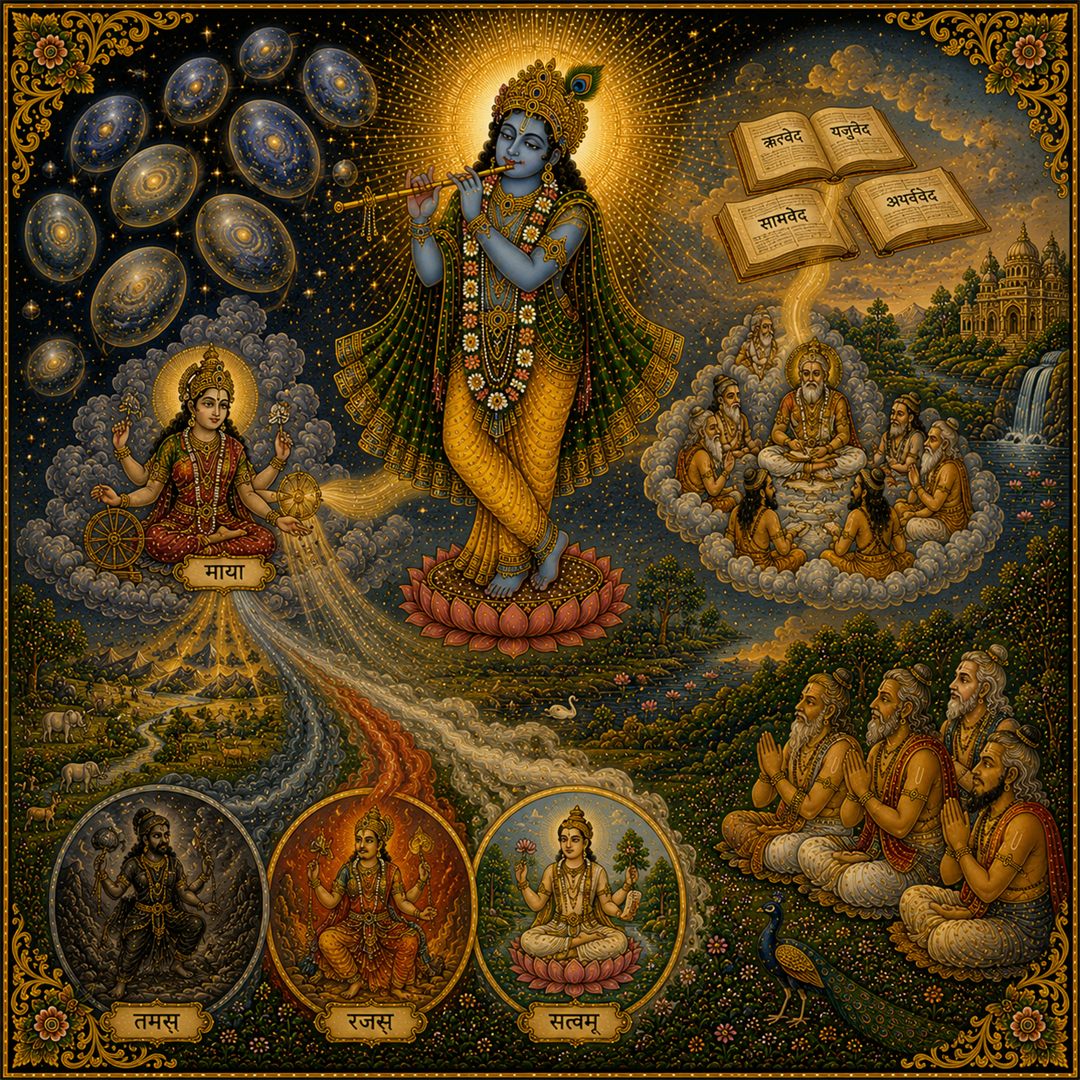
माया हि यस्य जगदण्डशतानि सूते त्रैगुण्यतद्विषयवेदवितायमाना । सत्त्वावलम्बिपरसत्त्वविशुद्धसत्त्वं गोविन्दमादिपुरुषं तमहं भजामि ॥ ४१ ॥
māyā hi yasya jagad-aṇḍa-śatāni sūte
traiguṇya-tad-viṣaya-veda-vitāyamānā
sattvāvalambi-para-sattva-viśuddha-sattvaṁ
govindam ādi-puruṣaṁ tam ahaṁ bhajāmi
I worship Govinda, the primeval Lord, whose māyā potency gives birth to hundreds of universes and unfolds the Vedic knowledge concerning the three modes of material nature and their objects. Yet He Himself is viśuddha-sattva, the pure para-sattva upon which material sattva rests.
māyā—the Lord’s external potency; hi—indeed; yasya—of whom; jagad-aṇḍa-śatāni—hundreds of universes; sūte—gives birth to, produces; traiguṇya—the three modes of material nature; tad-viṣaya—and the objects pertaining to them; veda-vitāyamānā—unfolding or expanding the Vedic knowledge; sattva-avalambi—upon which material sattva rests; para-sattva—transcendental sattva; viśuddha-sattvam—pure spiritual existence; govindam—Govinda; ādi-puruṣam—the primeval Lord; tam—Him; ahaṁ bhajāmi—I worship.
Dig-darśinī-ṭīkā
Śrī Jīva Gosvāmī
Having thus described the glory inherent in Govinda’s own nature, Brahmā now describes the glory related to Him in two verses.
First, he describes the inconceivable workings of His external potency, māyā, beginning with the verse māyā hi. Although māyā produces the material universes, Govinda Himself has no contact with her. This is indicated by the word sattva. The meaning is that He possesses pure, unmixed sattva, which is para-sattva, beyond material sattva mixed with rajas and tamas, and which consists of the functions of the spiritual potency (cit-śakti).
Thus the Viṣṇu Purāṇa states:
sattvādayo na santīśe yatra na prākṛtā guṇāḥ
sa śuddhaḥ sarva-śuddhebhyaḥ pumān ādyaḥ prasīdatu
“In the Supreme Lord there are no material qualities such as sattva, nor any of the other material modes. May that primeval Lord, who is purer than all that is pure, bestow His mercy.”
This subject has been explained in greater detail in the Śrī Bhagavat-sandarbha.
Brahma-saṁhitā-prakāśinī
Śrīla Bhaktivinoda Ṭhākura
Verse 41
I worship that primeval Lord Govinda, whose inferior potency, māyā, is constituted of the three guṇas—sattva, rajas, and tamas—and expands the Vedic knowledge concerning the material universes. He is pure spiritual existence (śuddha-sattva), established in transcendental sattva (para-sattva), which is the support of material sattva.
Creation is the function of the mode of passion (rajo-guṇa). After creation, maintenance takes place through sattva-guṇa mixed with rajas. Destruction is the function of the mode of ignorance (tamo-guṇa).
Sattva mixed with the three guṇas is material. But that sattva which is completely free from mixture with rajas and tamas is transcendental. That eternally existing transcendental reality is called para-sattva.
He whose essential nature is situated in that para-sattva is śuddha-sattva—free from māyā, beyond the material manifestation, beyond the guṇas (nirguṇa), and composed of eternal consciousness and bliss (sac-cid-ānanda).
Māyā has expanded all Vedic knowledge concerned with the three guṇas and the regulations governing the material world.
Annotations
Bhakti Gauravani Goswami
This verse introduces several important philosophical terms that are easily misunderstood: sattva, śuddha-sattva, para-sattva, and nirguṇa.
Sattva refers to the mode of goodness, one of the three modes of material nature (guṇas) together with rajas (passion) and tamas (ignorance). Because goodness produces knowledge, clarity, morality, and peacefulness, it is superior to the lower modes. Nevertheless, it remains a material condition and therefore belongs to the realm of māyā.
Consequently, Bhaktivinoda Ṭhākura distinguishes sattva, material goodness, from śuddha-sattva, pure spiritual existence. Śuddha-sattva is not sattva refined to its highest degree. It is an entirely different category of reality. Jīva Gosvāmī explains that it consists of the functions of the Lord’s spiritual potency (cit-śakti) and is completely free from any mixture of passion or ignorance.
For this reason the Lord is described here as para-sattva and viśuddha-sattva. The word para means “transcendental” or “beyond.” Thus para-sattva refers to the spiritual reality that exists beyond the material guṇas, while viśuddha-sattva emphasizes its completely pure and uncontaminated nature.
This also helps explain the meaning of the word nirguṇa, which frequently appears in the Upaniṣads, Purāṇas, and the Śrīmad-Bhāgavatam. The word literally means “without qualities,” leading some scholars to conclude that the Absolute Truth has no qualities and is therefore ultimately impersonal.
However, from the Vaiṣṇava perspective, nirguṇa means “free from the material guṇas,” not “without qualities.” Kṛṣṇa possesses unlimited qualities, but all of them belong to the realm of śuddha-sattva and are therefore transcendental, beyond material nature.
Thus the present verse describes two complementary truths. Māyā, with her three guṇas, gives birth to the material universes and expands the Vedic knowledge governing them, while Govinda remains forever beyond her influence, established in His eternal spiritual nature of viśuddha-sattva.