 Spiritual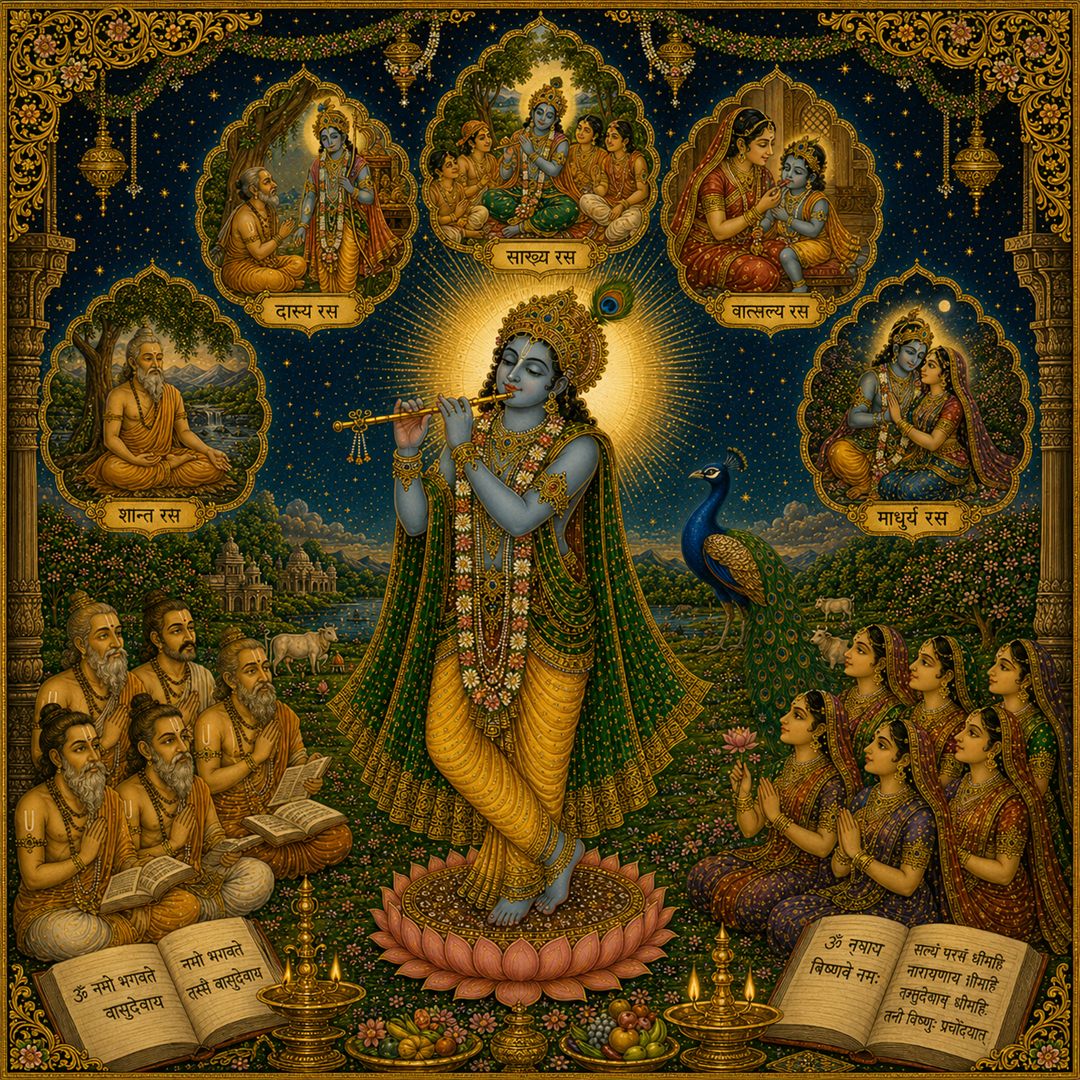
यद्भावभावितधियो मनुजास्तथैव सम्प्राप्य रूपमहिमासनयानभूषाः । सूक्तैर्यमेव निगमप्रथितैः स्तुवन्ति गोविन्दमादिपुरुषं तमहं भजामि ॥ ३६ ॥
yad-bhāva-bhāvita-dhiyo manujās tathaiva
samprāpya rūpa-mahimāsana-yāna-bhūṣāḥ
sūktair yam eva nigama-prathitaiḥ stuvanti
govindam ādi-puruṣaṁ tam ahaṁ bhajāmi
I worship Govinda, the primeval Lord. Human beings whose intelligence has been imbued with a particular devotional mood toward Him attain corresponding forms, glories, seats, vehicles, and ornaments, and they praise Him with the very hymns proclaimed in the Vedas.
yat-bhāva-bhāvita-dhiyaḥ—whose intelligence has been imbued with a particular devotional mood toward Him; manujāḥ—human beings; tathā eva—in that very manner; samprāpya—having attained; rūpa—forms; mahimā—glories, opulences; āsana—seats; yāna—vehicles; bhūṣāḥ—ornaments; sūktaiḥ—with hymns; yam eva—that very Lord; nigama-prathitaiḥ—proclaimed in the Vedas; stuvanti—they praise; govindam—Govinda; ādi-puruṣam—the primeval Lord; tam ahaṁ bhajāmi—Him I worship.
Dig-darśinī-ṭīkā
Śrī Jīva Gosvāmī
While describing the Lord’s generosity even toward devotees engaged in spiritual practice, Brahmā points out how much more this is true of His eternal associates. Thus the verse begins yad-bhāva-bhāvita-dhiyaḥ. The meaning is that, just as it is heard in the revealed texts that the gopas attain likeness to Him in qualities, character, age, sportive dealings, and dress, so the same should be understood here as well regarding His eternal companions.
Thus in the Eleventh Canto (11.5.48) Nārada states:
vaireṇa yaṁ nṛpatayaḥ śiśupāla-śālva
pauṇḍrādayo gati-vilāsa-vilokanādyaiḥ
dhyāyanta ākṛti-dhiyaḥ śayanāsanādau
tad-bhāvam āpur anurakta-dhiyāṁ punaḥ kim
“Śiśupāla, Śālva, Pauṇḍraka, and other kings were always thinking about Kṛṣṇa with envy. Even while they were lying down, sitting or engaging in other activities, their minds were fixed on His form, movements, playful pastimes, glances, and so on. Being thus always absorbed in Kṛṣṇa, they attained a position on the same level with Him. What, then, may be said of those whose minds are filled with loving devotion?”
Annotations 1
Bhakti Gauravani Goswami
The verse cited by Jīva Gosvāmī originally appears in a conversation between Nārada and Vasudeva in the Eleventh Canto of the Śrīmad-Bhāgavatam. Vasudeva, despite being Kṛṣṇa’s father, felt anxiety that he might not have fully utilized the opportunity of the Lord’s personal presence and wondered whether treating the Supreme Lord as his son could have constituted an offense. He was also concerned about the apparent destruction of the Yadu dynasty. Nārada reassured him by pointing out that even envious kings such as Śiśupāla, Śālva, and Pauṇḍraka attained liberation through constant absorption in Kṛṣṇa. If such perfection could be achieved through enmity, then what need be said of those whose minds are filled with love for Him? The verse therefore establishes a fundamental principle: one attains a result according to the nature and intensity of one’s absorption in Kṛṣṇa.
In the Seventh Canto, Nārada Muni explained a similar point to Mahārāja Yudhiṣṭhira who had inquired about the Lord’s impartiality. Nārada reassured the king that Viṣṇu had no enemy and no friend. When He chastises the demons it is for their good, and when He accepts the prayers of the devotees it is for their good. He then said (SB 7.1.26):
tasmād vairānubandhena nirvaireṇa bhayena vā
snehāt kāmena vā yuñjyāt kathañcin nekṣate pṛthak
“Therefore by enmity or by devotional service, by fear, by affection or by lusty desire—by all of these or any one of them—if a conditioned soul somehow or other concentrates his mind upon the Lord, the result is the same, for the Lord, because of His blissful position, is never affected by enmity or friendship.”
However, Śrīla Prabhupāda explains in the purport that to imitate demons like Śiśupāla is not the way to success:
From this verse one should not conclude that because Kṛṣṇa is unaffected by favorable prayers or unfavorable blasphemy one should therefore blaspheme the Supreme Lord. This is not the regulative principle. Bhakti-yoga means ānukūlyena kṛṣṇānuśīlanam: one should serve Kṛṣṇa very favorably. This is the real injunction. Here it is said that although an enemy thinks of Kṛṣṇa unfavorably, the Lord is unaffected by such antidevotional service. Thus He offers His benedictions even to Śiśupāla and similarly inimical conditioned souls. This does not mean, however, that one should be inimical toward the Lord. The stress is given to the favorable execution of devotional service, not purposeful blasphemy of the Lord. [...]
The conclusion is that one should not give up pure devotional service. For one’s own benefit, one should not imitate Hiraṇyakaśipu or Śiśupāla. This is not the way to achieve success.
A few verses later, Nārada elaborates on the Lord’s merciful nature:
gopyaḥ kāmād bhayāt kaṁso
dveṣāc caidyādayo nṛpāḥ
sambandhād vṛṣṇayaḥ snehād
yūyaṁ bhaktyā vayaṁ vibho
“My dear King Yudhiṣṭhira, the gopīs by their lusty desires, Kaṁsa by his fear, Śiśupāla and other kings by envy, the Yadus by their familial relationship with Kṛṣṇa, you Pāṇḍavas by your great affection for Kṛṣṇa, and we, the general devotees, by our devotional service, have obtained the mercy of Kṛṣṇa.”
In the purport to this verse, Prabhupāda points out:
Different persons achieve different types of mukti—sāyujya, sālokya, sārūpya, sāmīpya and sārṣṭi—according to their intense desire, which is called bhāva. […]
Kaṁsa and other enemies of Kṛṣṇa merged into the existence of Brahman, but why should Kṛṣṇa’s friends and devotees have the same position? Kṛṣṇa’s devotees attain the association of the Lord as His constant companions, either in Vṛndāvana or in the Vaikuṇṭha planets.
Brahma-saṁhitā-prakāśinī
Śrīla Bhaktivinoda Ṭhākura
Verse 36
I worship Govinda, the primeval Lord. Human beings whose hearts have been imbued with a particular devotional mood attain forms, glories, seats, vehicles, and ornaments corresponding to that mood. Endowed with these, they glorify Him with the hymns and mantras spoken in the Vedas.
According to the analysis of devotional rasa, there are five principal devotional moods: śānta, dāsya, sakhya, vātsalya, and śṛṅgāra or mādhurya.
Devotees established in each of these moods render constant service to the corresponding form of Kṛṣṇa and ultimately attain the destination appropriate to that particular relationship. They receive spiritual forms suited to their rasa, corresponding degrees of spiritual glory, suitable seats of service, appropriate vehicles, and transcendental ornaments that enhance the beauty of their spiritual forms.
Those qualified for śānta-rasa attain the realm of Brahman and Paramātmā, which is the abode of spiritual peace. Those qualified for dāsya-rasa attain the majestic realm of Vaikuṇṭha. Those qualified for pure sakhya-, vātsalya-, and mādhurya-rasa attain Goloka, which lies beyond Vaikuṇṭha.
In those respective abodes, having obtained all the facilities and paraphernalia appropriate to their particular rasa, they glorify the Lord according to the hymns described in the Vedas.
In certain places the personified Vedas, under the influence of the Lord’s spiritual potency, speak of His transcendental pastimes. The glorification and kīrtana of liberated devotees follow those indications.
Annotations 2
Bhakti Gauravani Goswami
Some statements in Bhaktivinoda Ṭhākura’s commentary may require clarification. He says that those qualified for śānta-rasa attain the realm of Brahman and Paramātmā (brahma-paramātmā-dhāma), while those qualified for dāsya-rasa attain the majestic realm of Vaikuṇṭha. At first glance, this may appear difficult to reconcile with other descriptions by Vaiṣṇava ācāryas, including statements by Śrīla Prabhupāda, that the land, water, trees, flowers, cows, and other creatures in Vṛndāvana serve Kṛṣṇa in śānta-rasa, and that Kṛṣṇa has personal servants such as Raktaka and Patraka whose mood is identified as dāsya-rasa.
The apparent contradiction is resolved when it is understood that Bhaktivinoda Ṭhākura is not attempting to provide an exhaustive classification of all manifestations of rasa throughout the spiritual world. Rather, he is identifying the realms in which particular devotional moods are most prominently or characteristically expressed.
Thus, in this context, śānta-rasa refers primarily to peaceful God-consciousness characterized by freedom from material desire and the absence of intimate active service. In that sense, realization of Brahman and Paramātmā may be associated with śānta.
Similarly, dāsya-rasa is not confined to Vaikuṇṭha. Bhaktivinoda Ṭhākura mentions Vaikuṇṭha because it is the realm in which reverential service (aiśvarya-maya dāsya) predominates. In Goloka, Kṛṣṇa’s servants perform their service within the intimate sweetness of Vraja rather than the atmosphere of majesty and awe that characterizes Vaikuṇṭha.
The passage should therefore be understood as presenting the principal or characteristic destinations associated with these devotional moods rather than as a exhaustive study of every manifestation of śānta-rasa and dāsya-rasa found within the spiritual world.