 Spiritual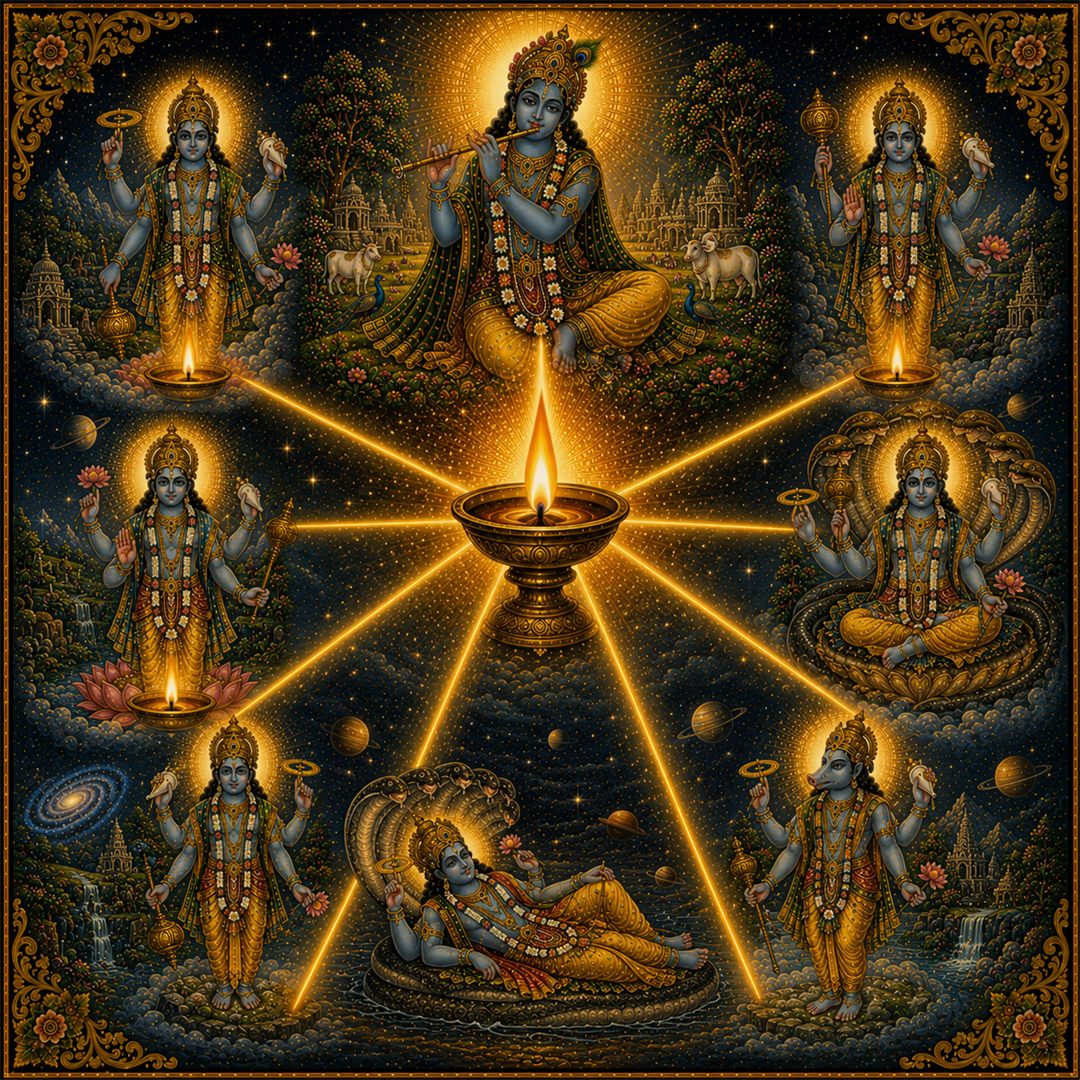
दीपार्चिरेव हि दशान्तरमभ्युपेत्य दीपायते विवृतहेतुसमानधर्मा ।
यस्तादृगेव हि च विष्णुतया विभाति गोविन्दमादिपुरुषं तमहं भजामि ॥ ४६ ॥
dīpārcir eva hi daśāntaram abhyupetya
dīpāyate vivṛta-hetu-samāna-dharmā
yas tādṛg eva hi ca viṣṇutayā vibhāti
govindam ādi-puruṣaṁ tam ahaṁ bhajāmi
I worship Govinda, the primeval Lord, who appears as Viṣṇu in just the same way that the flame of one lamp, entering another condition, burns as another lamp while possessing the same nature as the source from which it was kindled.
dīpa-arciḥ—the flame of a lamp; eva hi—indeed; daśā-antaram abhyupetya—having entered another condition; dīpāyate—burns as another lamp; vivṛta-hetu-samāna-dharmā—possessing the same nature as the manifest source; yaḥ—who; tādṛk eva—exactly in that manner; hi ca—indeed; viṣṇutayā—as Viṣṇu; vibhāti—appears, shines; govindam—Govinda; ādi-puruṣam—the primeval Lord; tam—Him; ahaṁ bhajāmi—I worship.
Dig-darśinī-ṭīkā
Śrī Jīva Gosvāmī
Now, describing the one form of Hari that comes next in sequence, and because Maheśa has just been discussed as a guṇāvatāra, Brahmā describes Viṣṇu, the guṇāvatāra. Thus the verse begins with dīpārcir eva. The reason for the similarity is given by the phrase vivṛta-hetu-samāna-dharmā (possessing the same nature as the original source).
Although it is understood that this Viṣṇu is an avatāra of Garbhodakaśāyī Viṣṇu, who is an expansion of Kāraṇārṇavaśāyī Viṣṇu, who in turn is an expansion of an expansion of Govinda, nevertheless the comparison is as follows: Just as the luminous portion of a fine, pure lamp, kindled in succession from a great lamp, possesses similarity with that original lamp, so Viṣṇu, as another form, is understood to possess similarity with Govinda.
Śambhu, however, because he presides over tamas, is comparable to a subtle lamp-flame filled with soot, and therefore he does not possess such similarity. Therefore this distinction is stated here.
Later, however, Mahā-Viṣṇu will also be shown to be a partial manifestation (kalā-viśeṣa) of Govinda.
Brahma-saṁhitā-prakāśinī
Śrīla Bhaktivinoda Ṭhākura
Verse 46
I worship that primeval Lord Govinda, who manifests Himself as Viṣṇu, just as the flame of one original lamp lights another lamp and burns separately, yet possesses the same illuminating nature as its source.
(The nature of the Lord’s plenary expansions (svāṁśa-tattva), known by the names Hari, Nārāyaṇa, and Viṣṇu and presiding over Hari-dhāma, is now being described.)
Nārāyaṇa, the Lord of the spiritual sky, is a pastime expansion (vilāsa-mūrti) of Kṛṣṇa. From Him proceeds the original puruṣa-avatāra; from Him proceeds Garbhodakaśāyī Viṣṇu; and from Him proceeds Kṣīrodakaśāyī Viṣṇu. The principle denoted by the name “Viṣṇu” pervades all these manifestations.
In this verse, by explaining the nature of Kṣīrodakaśāyī Viṣṇu, Brahmā establishes the nature of the Lord’s plenary expansions (svāṁśa-vilāsa).
Viṣṇu, the guṇāvatāra, who presides over the mode of goodness, is entirely distinct from Śambhu, who is connected with the material guṇas. Govinda and Viṣṇu possess the same essential nature. Both are constituted of pure goodness (śuddha-sattva). Viṣṇu possesses the same qualities as Govinda because He is manifested from Him as an expansion.
The material mode of goodness found within māyā is impure because it is mixed with passion and ignorance. Brahmā is a separated expansion (vibhinnāṁśa) invested with a manifestation arising from the mode of passion, while Śambhu is a separated expansion invested with a manifestation arising from the mode of ignorance.
The reason for the designation vibhinnāṁśas is that the modes of passion and ignorance belong entirely to the realm of unconscious matter (acit), and therefore the manifestations arising through them stand at a considerable distance from the Lord’s original form and His direct expansions.
Although the material mode of goodness is mixed, it reflects a portion of pure goodness. Viṣṇu, the guṇāvatāra, manifests through that pure aspect. Therefore Viṣṇu is a complete plenary expansion (pūrṇa svāṁśa-vilāsa) and belongs to the category of Mahā-īśvara. He is not touched by Māyā, although He is the Lord of Māyā.
Viṣṇu is the very expansion and manifestation of Govinda, who is the original source and possessor of all energies.
In Nārāyaṇa, the Lord’s pastime expansion, all of Govinda’s opulences, namely the sixty qualities, are present in completeness. Therefore, unlike Brahmā and Śiva, whose manifestations are associated with the material guṇas, Viṣṇu, although called a guṇāvatāra, is not touched by the material modes.
The manifestation of Nārāyaṇa as Mahā-Viṣṇu, of Mahā-Viṣṇu as Garbhodakaśāyī Viṣṇu, and of Garbhodakaśāyī Viṣṇu as Kṣīrodakaśāyī Viṣṇu constitutes an example of the principle illustrated by the lamp analogy.
Viṣṇu alone is īśvara. The other two guṇāvatāras and all the demigods are subordinate administrative authorities under Him.
From Govinda, the great original lamp, are manifested through the agency of His spiritual potency separate lamps in the form of His pastime expansions: Mahā-Viṣṇu, Garbhodakaśāyī Viṣṇu, Kṣīrodakaśāyī Viṣṇu, and the various plenary avatāras such as Lord Rāma.
Annotations
Bhakti Gauravani Goswami
The analogy of the lamp in this verse complements the milk-and-yogurt analogy of the previous verse. Śambhu is compared to milk transformed into yogurt, indicating a unique state that is neither completely identical with nor entirely separate from its source. Viṣṇu, however, is compared to one lamp lighting another lamp. Although the second lamp is kindled from the first, both flames possess the same illuminating nature. The purpose of the analogy is to show that Viṣṇu possesses the very same divine nature as Govinda because He is His direct plenary expansion, whereas Śambhu occupies a unique existential position connected with a particular transformative function within material creation.