 Spiritual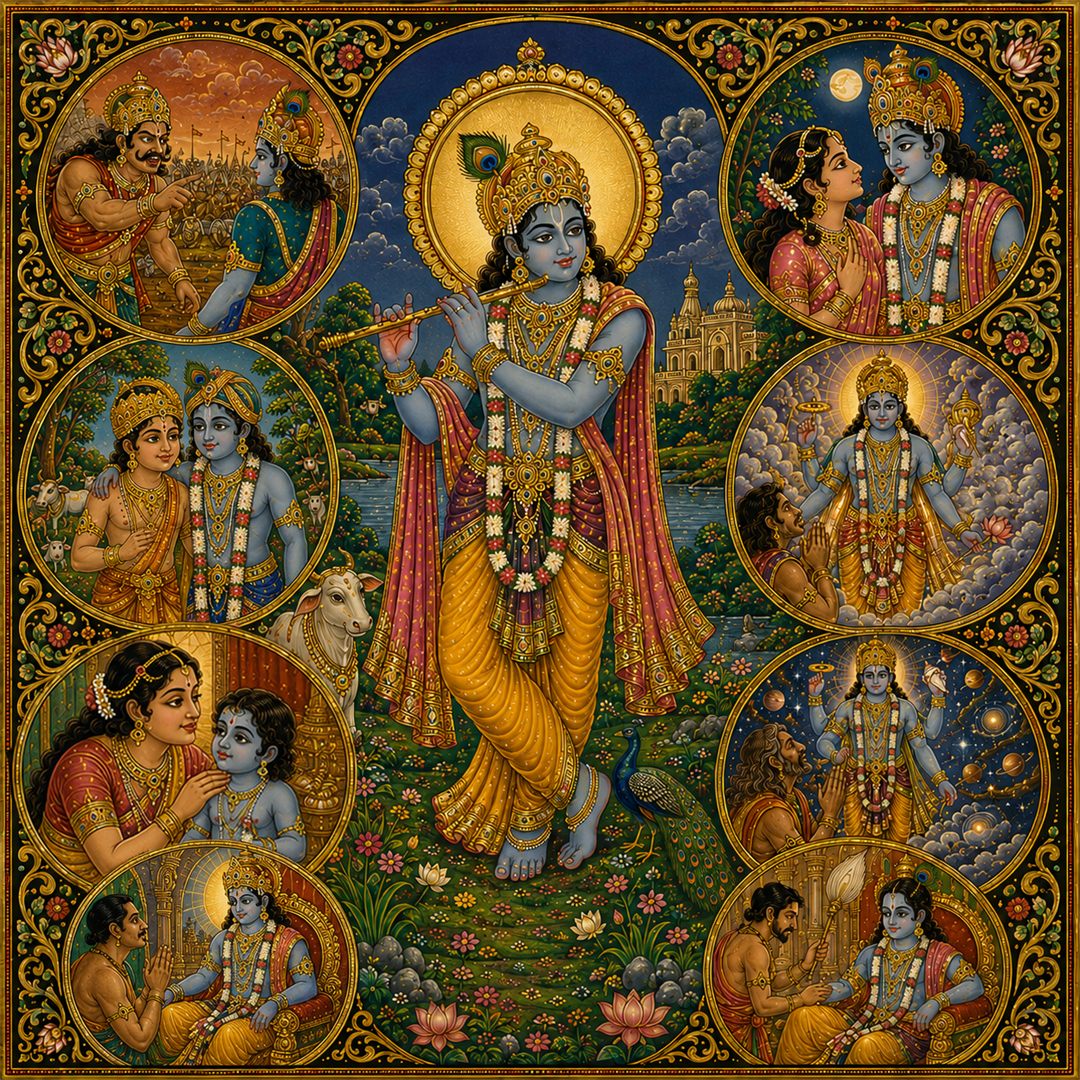
यं क्रोधकामसहजप्रणयादिभीतिवात्सल्यमोहगुरुगौरवसेव्यभावैः ।
सञ्चिन्त्य तस्य सदृशीं तनुमापुरेते गोविन्दमादिपुरुषं तमहं भजामि ॥ ५५ ॥
yaṁ krodha-kāma-sahaja-praṇayādi-bhīti-
vātsalya-moha-guru-gaurava-sevya-bhāvaiḥ
sañcintya tasya sadṛśīṁ tanum āpur ete
govindam ādi-puruṣaṁ tam ahaṁ bhajāmi
I worship Govinda, the primeval Lord. Those who meditated upon Him through anger, amorous desire, natural loving friendship, fear, parental affection, bewilderment, reverential regard, or the mood of service attained forms similar to His.
yam—whom; krodha—through anger; kāma—amorous desire; sahaja-praṇaya—natural affectionate friendship; ādi—and so forth; bhīti—fear; vātsalya—parental affection; moha—bewilderment, absorption in forget-fulness of all else; guru-gaurava—reverential respect; sevya-bhāvaiḥ—moods of service; sañcintya—meditating upon; tasya sadṛśīm tanum—a form similar to His; āpuḥ ete—they attained; govindam—Govinda; ādi-puruṣam—the primeval Lord; tam—Him; ahaṁ bhajāmi—I worship.
Dig-darśinī-ṭīkā
Śrī Jīva Gosvāmī
Indeed, He personally bestows upon even His enemies a result that is difficult for others to attain. What, then, may be said of those superior souls who are free from selfish desire and approach Him through desire directed toward Him and other such sentiments? Therefore, who else could possibly be worthy of worship?
Thus Brahmā concludes the section of verses ending with the words tam ahaṁ bhajāmi with the words yaṁ krodha...
Sahaja-praṇaya means friendship (sakhya).
Vātsalya means the affection appropriate to parents and similar relations.
Moha means a state of complete forgetfulness of everything else, such as absorption in Him under the conception of the Supreme Brahman.
Guru-gaurava means regarding Him as one’s father or another superior worthy of reverence.
Sevya-bhāva means the conception “He is my Lord to be served,” or in other words, the mood of servitude (dāsya).
The phrase tasya sadṛśīṁ tanum means that those who meditated upon Him attained forms similar to His.
In the case of those absorbed in anger, the similarity extends only to transcendence beyond ordinary material existence. In the other cases, however, the degree of similarity varies according to the extent to which the particular form and qualities appropriate to each mood are attained.
This understanding is supported by statements such as this one, spoken by Śrī Vāsudeva [Kṛṣṇa]: adṛṣṭvānyatamaṁ loke śīlaudārya-guṇaiḥ samam, “Nowhere in this world have I found anyone equal to you [Devakī and Vasudeva] in character, generosity, and qualities”; by the Brahma-sūtra’s declaration jagad-vyāpāra-varjam, “except for the functions of universal creation and governance”; and by Nārada’s statement prayojyamāne mayi tāṁ śuddhāṁ bhāgavatīṁ tanum, “I obtained that pure spiritual form.” Previously, while discussing the verse vaireṇa yaṁ nṛpatayaḥ..., “The kings attained Him through enmity...,” the conclusion was reached with the words anurakta-dhiyāṁ punaḥ kim: “What then may be said of those whose minds are filled with love?”
There the devotees were glorified. One might therefore conclude that all devotees attain the same result. However, even among devotees there are gradations corresponding to the degree of their particular attachment and love. By this verse it is also demonstrated that Kṛṣṇa in Goloka and Kṛṣṇa who descends into the material world are one and the same person.
Thus it is said: nandādayas tu taṁ dṛṣṭvā... “When Nanda and the others saw that realm...” and so forth.
Brahma-saṁhitā-prakāśinī
Śrīla Bhaktivinoda Ṭhākura
Verse 55
I worship Govinda, the primal Lord. By meditating upon Him through anger, desire, natural friendship, fear, parental affection, bewilderment, reverential regard, or the mood of service, those who cultivate such dispositions attain corresponding spiritual forms, with varying degrees of the forms and qualities appropriate to their respective contemplations.
Bhakti is of two kinds: vaidhī-bhakti and rāgātmikā-bhakti.1 Devotional service rooted in the measure of faith that arises solely through the instructions of Scripture and the spiritual master remains bound by scriptural injunctions. Through continued endeavor in the cultivation of devotion to Kṛṣṇa, it gradually becomes permeated with bhāva. When bhāva awakens, the devotee becomes a recipient of Kṛṣṇa’s full mercy. Because considerable time is generally required to attain this state, this is known as vaidhī-bhakti.
Rāgātmikā-bhakti, however, whose essential nature is spontaneous attachment, is superior. It yields its fruit quickly and powerfully attracts Kṛṣṇa. The various forms in which it appears are described in this verse. The mood of regarding Him with reverential respect as father or another superior corresponds to śānta-rasa. The mood of serving the worshipable Lord corresponds to dāsya-rasa. Natural loving friendship corresponds to sakhya-rasa. Parental affection corresponds to vātsalya-rasa, and amorous desire corresponds to mādhurya-rasa. These constitute the devotional relationships within rāgātmikā-bhakti.
Anger, fear, and bewilderment, although they may possess the intensity of rāga, are not bhakti, because they contain an unfavorable disposition rather than a favorable one. The anger of demons such as Śiśupāla, the fear of Kaṁsa and others, and the bewilderment of Māyāvādī scholars are examples. Such persons possess rāgātmikā, intense absorption, in Kṛṣṇa through anger, fear, or the bewildered absorption of identifying the self with Brahman while forgetting everything else. Yet because these attitudes lack favorable disposition toward Him, they cannot be considered bhakti.
Among the five moods of śānta, dāsya, sakhya, vātsalya, and śṛṅgāra, the śānta mood contains a considerable element of detachment and is therefore almost devoid of rāga. Nevertheless, because it contains some favorable disposition toward the Lord, it is counted among the forms of bhakti. In the remaining four moods, rāga is present in great abundance.
In accordance with Kṛṣṇa’s promise in the Bhagavad-gītā—ye yathā māṁ prapadyante tāṁs tathaiva bhajāmy aham (“As all surrender unto Me, I reward them accordingly”)—those who cultivate absorption through anger, fear, or bewilderment attain sāyujya-mukti. Those situated in śānta-rasa attain forms characterized by realization of Brahman and Paramātmā. Those situated in dāsya-rasa and sakhya-rasa attain, according to their respective qualifications, forms constituted of the appropriate masculine and feminine spiritual nature. Those situated in vātsalya-rasa attain forms suitable for parental affection. Those situated in śṛṅgāra-rasa attain pure gopī forms.
Annotations
Bhakti Gauravani Goswami
When reading the opening sentence in Bhaktivinoda Ṭhākura’s commentary, “Bhakti is of two kinds: vaidhī-bhakti and rāgātmikā-bhakti,” one may wonder whether there is a mistake in the translation. Should rāgātmikā-bhakti instead be rāgānugā-bhakti? After all, as Rūpa Gosvāmī explains in the Bhakti-rasāmṛta-sindhu, rāgātmikā-bhakti is the spontaneous devotion eternally present in the residents of Vraja, whereas rāgānugā-bhakti is part of sādhana-bhakti, the devotional practice of following in the footsteps of these rāgātmikā devotees.
The original Bengali, however, explicitly uses the term rāgātmikā-bhakti. It appears that Bhaktivinoda Ṭhākura employs rāgātmikā more broadly in its etymological sense of “having rāga, or intense attachment.” This is evident from his statement that anger, fear, and bewilderment may also possess the intensity of rāga, although they are not bhakti because they are unfavorable to Kṛṣṇa.
Some of Kṛṣṇa’s enemies, such as Śiśupāla, remained constantly absorbed in Him through envy and hatred; Kaṁsa constantly remembered Him through fear. The Māyāvādī scholars become absorbed in the impersonal Brahman by forgetting His personal form, whereas the residents of Vraja meditate upon Him through friendship, parental affection, or conjugal love. In each case, Kṛṣṇa reciprocates according to the disposition with which He is approached, fulfilling His declaration in the Bhagavad-gītā (4.11): ye yathā māṁ prapadyante tāṁs tathaiva bhajāmy aham. “As all surrender unto Me, I reward them accordingly.”
Jīva Gosvāmī and Bhaktivinoda Ṭhākura therefore make an important distinction: Anger, fear, and bewilderment may produce rāgā, intense absorption, in Kṛṣṇa, but because they are unfavorable rather than favorable, they do not constitute bhakti. They may lead to liberation, but they do not establish an eternal loving relationship with the Supreme Lord.
Pure devotional service begins when one’s attitude becomes favorable to Kṛṣṇa. As Rūpa Gosvāmī explains at the beginning of his work Bhakti-rasāmṛta-sindhu (1.1.11):
anyābhilāṣitā-śūnyaṁ jñāna-karmādy-anāvṛtam
ānukūlyena kṛṣṇānu-śīlanaṁ bhaktir uttamā
“When first-class devotional service develops, one must be devoid of all material desires, knowledge obtained by monistic philosophy, and fruitive action. The devotee must constantly serve Kṛṣṇa favorably, as Kṛṣṇa desires.”
The moods of reverence, service, friendship, parental affection, and especially conjugal love are therefore genuine expressions of bhakti. As love deepens, the devotee attains a corresponding eternal spiritual form suitable for serving Kṛṣṇa in that particular relationship.
This verse demonstrates, therefore, that not all forms of absorption lead to the same destination. Although all intense absorption in Kṛṣṇa produces a result, only favorable devotional service establishes a loving relationship with Govinda and is the path that will lead us to enter and participate in His eternal pastimes.
Notes
- See Annotations for a detailed explanation. ↩