 Spiritual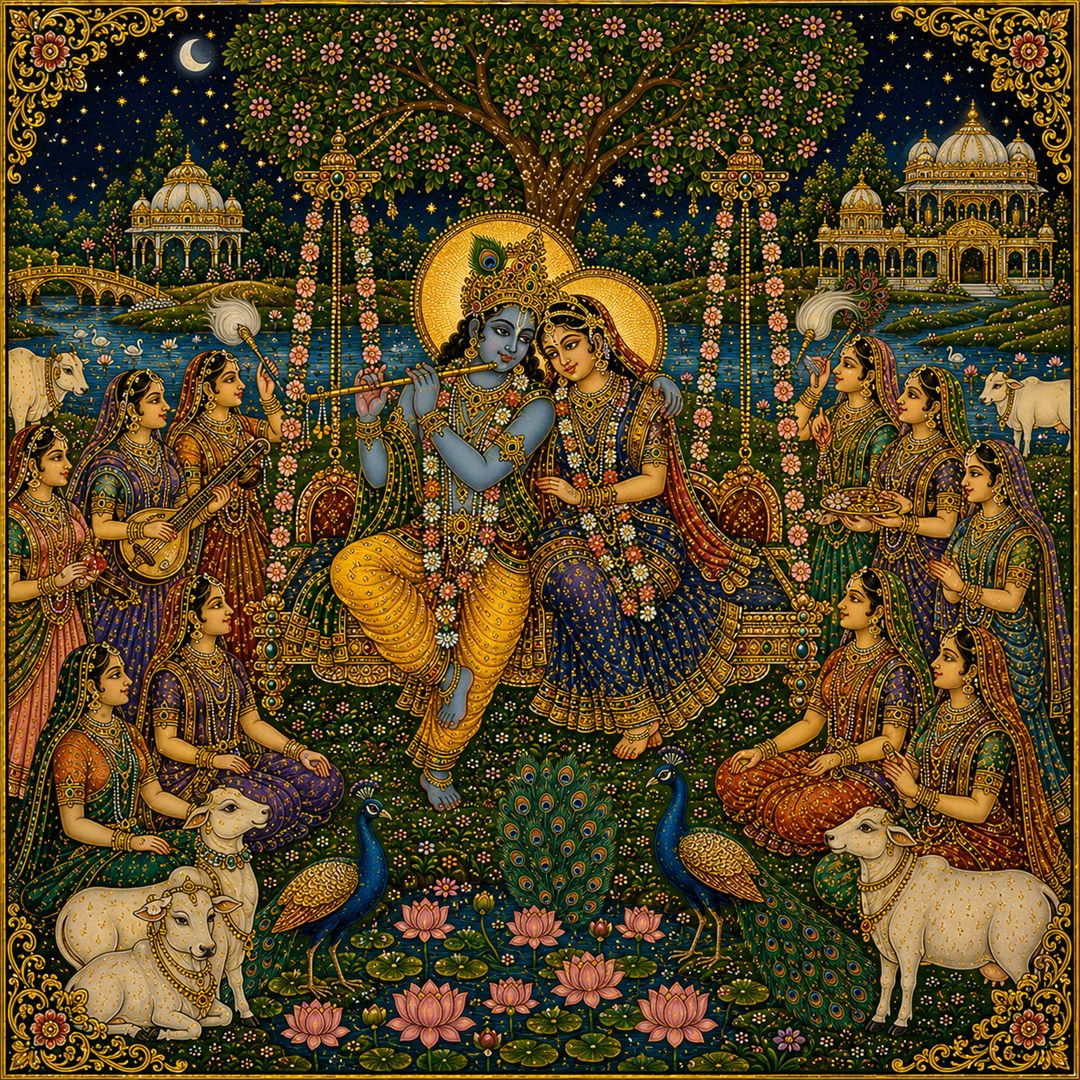
आनन्दचिन्मयरसप्रतिभाविताभिस्ताभिर्य एव निजरूपतया कलाभिः ।
गोलोक एव निवस्यखिलात्मभूतो गोविन्दमादिपुरुषं तमहं भजामि ॥ ३७ ॥
ānanda-cinmaya-rasa-pratibhāvitābhis
tābhir ya eva nija-rūpatayā kalābhiḥ
goloka eva nivasaty akhilātma-bhūto
govindam ādi-puruṣaṁ tam ahaṁ bhajāmi
I worship Govinda, the primeval Lord, who, although He is the self of all, resides only in Goloka with those expansions of His own form who are fully imbued with blissful spiritual rasa.
ānanda-cinmaya-rasa—blissful spiritual rasa; pratibhāvitābhiḥ—permeated, fully imbued; tābhiḥ—with them; yaḥ eva—He who indeed; nija-rūpatayā—as His own forms; kalābhiḥ—with expansions or potencies; goloke eva—only in Goloka; nivasati—resides; akhila-ātma-bhūtaḥ—being the self of all; govindam—Govinda; ādi-puruṣam—the primeval Lord; tam ahaṁ bhajāmi—Him I worship.
Dig-darśinī-ṭīkā
Śrī Jīva Gosvāmī
What then need be said of Govinda’s beloveds? Since He resides in that realm only in the company of those supreme goddesses of fortune, Brahmā now declares: ānanda-cinmaya-rasa-pratibhāvitābhiḥ. “The ānanda-cinmaya-rasa is the supreme divine love known as ujjvala-rasa. The gopīs are pervaded and fully imbued with that rasa.”
Alternatively, the meaning may be understood as follows: First there is that rasa, and by that rasa Govinda is worshiped and realized; then, because the gopīs are completely permeated by that same rasa, He resides together with them. This meaning is implied by the prefix prati in pratibhāvitābhiḥ.
Although all the residents of Goloka and all His other beloved associates are exceedingly dear to Him, this verse shows the unsurpassed excellence of the gopīs, for He resides exclusively with them, even though all others are also dear to Him as His self. The reason is given by the word kalābhiḥ, which indicates that they are manifestations of the functions of His hlādinī-śakti.
A further distinction is then indicated. Just as, from a statement such as, “He was benefited by him,” one understands that the other person had first rendered the benefit, so here also a prior relationship is implied. Therefore the term nija-rūpatayā means that they exist as His consorts, and not under the convention of being others’ wives as appears in the manifest earthly pastimes, for it is impossible that these supreme Lakṣmīs could actually be the wives of others. Rather, in the manifest pastimes, for the sake of heightening amorous relish through the intense eagerness produced when the rasa of their being His own consorts is veiled by playful intrigue, Yogamāyā alone manifests the appearance of such a condition.
The emphatic particle eva in ya eva indicates that the very same Lord who, in His manifest earthly pastimes, appears to reside among them under the convention that they are married to others, resides in Goloka, the abode of His unmanifest pastimes, under the convention that they are His consorts. Thus the Gautamīya-tantra explains in its exposition of the syllables relating to the eternal manifest pastimes: aneka-janma-siddhānāṁ gopīnāṁ patir eva vā. “He alone is the husband of the gopīs, who are perfected through many births.”
And by the words goloka eva it is made clear that this particular līlā exists nowhere else.
Brahma-saṁhitā-prakāśinī
Śrīla Bhaktivinoda Ṭhākura
Verse 37
I worship that primeval Lord Govinda, the Soul of all souls, who eternally resides in His abode of Goloka together with Śrī Rādhā. She is His pleasure potency (hlādinī-śakti), permeated with the blissful spiritual mellow (ānanda-cinmaya-rasa), corresponding to His own spiritual nature, and endowed with sixty-four arts. He is also accompanied by the sakhīs, who are expansions of Her form.
Although the potency (śakti) and the possessor of the potency (śaktimān) are one reality, Rādhā and Kṛṣṇa eternally exist as two distinct persons through the agency of the pleasure potency (hlādinī-śakti). Within both ānanda (Rādhā, the pleasure potency) and cit (Kṛṣṇa) exists the inconceivable conjugal mellow (śṛṅgāra-rasa).
This rasa has two kinds of stimulating causes: the supporting basis and the stimulus. The supporting basis is further divided into two: the repository (āśraya) and the object (viṣaya). Śrī Rādhikā and Her expansions are the repository, while Śrī Kṛṣṇa Himself is the object. Kṛṣṇa is Govinda, the Lord of Goloka. The gopīs, being permeated with this rasa, constitute its repository, and with them Kṛṣṇa performs His eternal pastimes in Goloka.
The phrase “corresponding to His form” (nijarūpatayā) means that Śrī Rādhā is accompanied by the arts (kalās), which are manifested expressions of the pleasure potency. These sixty-four arts are:
Dancing; singing; playing musical instruments; performing dramas; painting; decorating the body; making designs with rice and flowers; arranging flower beds; decorating the teeth, garments, and limbs; inlaying floors with jewels; making beds; producing music with water-filled vessels; engaging in water sports; painting pictures; weaving flower garlands; preparing floral ornaments for the head; designing costumes; designing earrings; blending perfumes; arranging jewelry; performing magic and conjuring; practicing the amorous arts; performing sleight of hand; preparing decorative foods and sweets; mixing beverages; doing needlework; making string figures; solving riddles; reciting poetry; solving difficult verbal puzzles; reading aloud; narrating dramatic stories; completing poetic compositions; weaving baskets and cane work; spinning thread; practicing carpentry; designing buildings; assaying silver and jewels; working with metals; recognizing the colors of gems; identifying mines; caring for trees; arranging contests between rams and cocks; teaching parrots and mynah birds to speak; giving massages; dressing hair; writing and deciphering secret codes; speaking foreign languages; interpreting floral omens; constructing mechanical devices; memorizing efficiently; composing poetry extemporaneously; composing literary works; adopting disguises; mastering lexicography, studying poetic meters and the art of versification; draping garments skillfully; playing dice; playing attractive games; entertaining children; practicing ethics; mastering the science of victory; and practicing the art of the bard.
All these arts exist eternally in Goloka in their original, personified forms as manifestations of spiritual rasa. In the material world they are beautifully manifested in Kṛṣṇa’s Vraja pastimes through the agency of the spiritual potency (cit-śakti) and Yogamāyā.
For this reason Śrī Rūpa Gosvāmī has written:
Śrī Hari eternally shines with His unlimited manifestations and pastimes. Sometimes one such manifestation appears within the material world. He manifests His pastimes beginning with His birth together with His eternal associates. The potency known as līlā-śakti, following Kṛṣṇa’s mood, inspires those same moods within His associates. Those pastimes that become visible within the material world are called manifest (prakaṭa) pastimes. Those of the same nature, which remain beyond the material world, shine as unmanifest (aprakaṭa) pastimes. Within the manifest pastimes, Kṛṣṇa’s comings and goings take place in Gokula, Mathurā, and Dvārakā. Those same pastimes, which are unmanifest in these three places, are eternally manifest in Vṛndāvana and the other places of the spiritual world.
The meaning is as follows: Kṛṣṇa eternally shines in Goloka through His unlimited manifestations of pastimes. Occasionally, one of those manifestations appears within the material world. Together with His eternal associates, Śrī Hari manifests His pastimes beginning with His birth. The līlā-śakti, following Kṛṣṇa’s mood, inspires those same moods within His associates. Those pastimes that become visible within the material world are called manifest pastimes, whereas all of Kṛṣṇa’s pastimes eternally exist in Goloka as unmanifest pastimes beyond the material world. Within the manifest pastimes, Kṛṣṇa moves between Gokula, Mathurā, and Dvārakā. Those same pastimes, which are unmanifest there, are eternally manifest in Vṛndāvana and the other places of the spiritual world. From these conclusive statements it should be understood that there is no difference between the manifest and unmanifest pastimes.
In his commentary on this verse, as well as in his commentary on the Ujjvala-nīlamaṇi, the Kṛṣṇa-sandarbha, and other works, our tattva-ācārya, Śrī Jīva Gosvāmī, explains at length that Kṛṣṇa’s manifest pastimes are arranged by Yogamāyā. Because these pastimes appear in connection with the material world, certain features, such as the killing of demons, Kṛṣṇa’s relationships with the wives of others, and His birth, appear within them through Yogamāyā’s arrangement. Since the gopīs belong to Kṛṣṇa’s intrinsic potency (svarūpa-śakti), they are eternally His. How, then, could they actually be the wives of others? Whatever appearance of their belonging to other husbands is seen in the manifest pastimes is simply an impression created by māyā (māyika-pratyaya).
If the deeper intention underlying Śrī Jīva Gosvāmī’s statements is properly understood, no room for doubt remains. Śrī Jīva Gosvāmī is our tattva-ācārya. Always acting under the guidance of Śrī Rūpa and Śrī Sanātana, and being himself an eternal mañjarī in Kṛṣṇa’s pastimes, he fully understands these truths. Failing to grasp his intention, some people construct their own interpretations and argue either for or against various conclusions.
According to Śrī Rūpa and Śrī Sanātana, the manifest and unmanifest pastimes are nondifferent. One is manifest beyond the material world and the other within it; this alone distinguishes them. In the manifestation beyond the material world, both the seer and the object seen are perfectly pure.
When a soul, by the accumulation of great spiritual merit, receives Kṛṣṇa’s mercy, gives up all connection with the material world and enters the spiritual realm, and when that soul has attained perfection in relishing the various rasas during the stage of devotional practice (sādhana), then they can fully behold and relish the completely pure pastimes of Goloka. Such souls are exceedingly rare.
Even while still living in the material world, however, one who, by the perfection of devotional service and Kṛṣṇa’s mercy, has awakened the experience of spiritual mellow (cid-rasa) can perceive those Goloka pastimes within Kṛṣṇa’s earthly Gokula pastimes. Even among such qualified devotees there are degrees of realization. Until one attains full realization (vastu-siddhi), traces of māyā-based obstacles remain in one’s vision of Goloka’s pastimes. Likewise, according to the degree of realization of one’s eternal spiritual identity (svarūpa-siddhi), the vision of one’s spiritual form varies, and accordingly one’s vision of Goloka also differs.
Those who are completely bound by māyā lack the eye of devotion. Among them, some are simply absorbed in māyā’s countless varieties, while others, taking shelter of knowledge opposed to devotion, await ultimate dissolution. Even if such persons witness Kṛṣṇa’s manifest pastimes, they perceive only a material impression, completely disconnected from the unmanifest reality. Thus the vision of Goloka depends upon the qualification of the observer.
The essential point is this: Just as Goloka is a realm of pure spiritual reality, Gokula is equally pure and completely free from material contamination, although it is manifested within the material world by Yogamāyā through the agency of the spiritual potency (cit-śakti). Neither the manifest nor the unmanifest pastimes contain even the slightest trace of physicality, inferiority, or imperfection. Such ideas arise solely from the lack of qualification of the individual living being who beholds them.
Material contamination, inferiority, superimposition, illusion, ignorance, impurity, triviality, insignificance, and grossness belong only to the materially conditioned eyes, intelligence, mind, and false ego of the observer; they never belong to the object perceived. To the extent that these defects are removed, to that same extent one perceives reality in its purity. Whatever truths are revealed in the Scriptures are themselves entirely pure; they appear pure or impure only according to the qualification of the person who studies them.
The sixty-four arts described here exist eternally in Goloka in their original, pure form. Impressions of inferiority, triviality, or grossness arise only according to the level of qualification of those who contemplate them. According to Śrī Rūpa and Śrī Sanātana, all the pastimes manifested in Gokula exist eternally in Goloka in their complete, perfectly pure form, free from the influence of māyā. Therefore the mood of paramour love (parakīya-bhāva) must also exist there in some inconceivably pure form.
Everything manifested by Yogamāyā is pure. Therefore the mood concerning another man’s wife (paradāra-bhāva), being arranged by Yogamāyā, must likewise have its basis in a pure reality. What, then, is that pure reality? Śrī Rūpa Gosvāmī writes:
Among the four types of heroes beginning with the dhīrodātta, two distinctions are recognized here: pati (husband) and upapati (paramour). One who accepts a maiden’s hand in marriage according to religious law is called a pati. One who, impelled by passionate love (rāga), transgresses the laws of religion to attain another man’s wife, considering her love to be his very life, is called an upapati by the wise. Whatever fault is described here applies only to worldly heroes, never to Kṛṣṇa, who descends solely to relish the essence of rasa..
Concerning the heroine, he further writes:
She who is described as another man’s wife within the primary conjugal rasa is so designated only according to the conventions governing ordinary worldly heroines.
On the strength of these verses, Śrī Jīva Gosvāmī argues at length that the sentiment of belonging to another man’s wife (paradāra-bhāva), like Kṛṣṇa’s birth pastimes arranged by Yogamāyā, is a playful illusion (vibhrama-vilāsa). Through the statement, “He is the husband of the women of the city and the paramour of the women of Vraja,” Śrī Jīva reveals his deeper intention.
Śrī Rūpa and Śrī Sanātana likewise accept this playful illusion arranged by Yogamāyā. Nevertheless, since Śrī Jīva Gosvāmī establishes the essential oneness of Goloka and Gokula, it must also be accepted that every pastime manifested in Gokula has its eternal foundation in Goloka.
Applying these definitions to Goloka, one who accepts a maiden’s hand according to the prescribed rites of marriage is a pati, whereas one who, impelled by rāga, transgresses religious law in order to attain another man’s wife, regarding her love as his very life, is an upapati. In Goloka, however, there is no dharma consisting of bondage to the institution of marriage; therefore patitva, husbandhood in this sense, does not exist there. Likewise, because the gopīs, who belong to Kṛṣṇa’s intrinsic potency (svarūpa-śakti), are not married to anyone else, literal upapatitva, the status of being their paramour, does not exist there either. Thus svakīya and parakīya cannot exist there as two separately established conditions.
Within the manifest pastimes of the material world, however, the institution of marriage does exist, and Kṛṣṇa transcends its restrictions. Therefore Yogamāyā arranges the sphere of sweetness (mādhurya-maṇḍala) in such a way that Kṛṣṇa relishes the rasa of paramour love (parakīya-rasa) by apparently transgressing the law of dharma.
This apparent transgression, arranged by Yogamāyā, is perceived only through the materially conditioned vision of those who inhabit the material world. In reality, no such fault exists in Kṛṣṇa’s pastimes.
Since parakīya-rasa is the crown jewel of all spiritual rasas, to deny its existence in Goloka would diminish the perfection of Goloka itself. It cannot be that the highest spiritual abode is devoid of the highest spiritual rasa. Kṛṣṇa, the source of all avatāras, relishes this rasa in one manner in Goloka and in another in Gokula. Therefore, although the materially conditioned observer perceives an apparent transgression in the sentiment of belonging to another man (paradāra-bhāva), that sentiment possesses an eternal, pure reality in Goloka.
The scriptural statements, “Although He is self-satisfied, He nevertheless enjoyed loving pastimes;” “His amorous enjoyment is entirely contained within Himself,” and “He sported with the beautiful damsels of Vraja just as a child plays with his own reflection,” all establish that complete self-satisfaction (ātmārāmatā) is Kṛṣṇa’s intrinsic nature.
In the majestic spiritual world (aiśvarya-maya cid-jagat), Kṛṣṇa manifests His potency as Lakṣmī and enjoys relationships in the mood of wedded love (svakīya). Because that mood predominates there, the exchange of rasa beautifully extends only up to servitude (dāsya-rasa).
In Goloka, however, Kṛṣṇa expands His potency into hundreds of thousands of gopīs and, forgetting that they are His potency, eternally enjoys loving pastimes with them.
Because the mood of wedded love (svakīya-bhāva) does not make rasa especially rare or intense, the gopīs have, from beginningless time, possessed the eternal self-conception (abhimāna) of belonging to another man (paroḍhā). Kṛṣṇa likewise accepts the corresponding self-conception of being their paramour (aupāpatya-abhimāna) and performs the rāsa dance and His other pastimes with the gopīs, whom He summons with the sound of His flute. Goloka is the eternal, transcendental abode of rasa beyond the influence of māyā; therefore, there the flow of rasa is perfected through this self-conception (abhimāna) alone.
Similarly, parental affection (vātsalya-rasa) directed toward the original Personality of Godhead does not exist in Vaikuṇṭha. Such is the nature of divine majesty (aiśvarya). In Goloka, however, which is supremely filled with sweetness (mādhurya), parental love exists solely on the foundation of self-conception (abhimāna).
Nanda and Yaśodā eternally exist there, but Kṛṣṇa’s birth does not. Since there is no actual birth, their identity as Kṛṣṇa’s father and mother is not established through a historical event but solely through their eternal self-conception (abhimāna), as expressed in the statement: “Glory to Him who dwells among His devotees and who is spoken of as having been born from Devakī.”
That eternal self-conception alone perfects the rasa. Likewise, in conjugal love (śṛṅgāra-rasa), if the condition of belonging to another man (paroḍhātva) and the condition of being a paramour (aupāpatya) exist eternally only as self-conceptions (abhimāna), then no fault whatsoever can arise, nor does this contradict any scriptural conclusion.
When the reality of Goloka becomes manifest within Vraja, these two self-conceptions appear in a somewhat more tangible form to those whose vision is conditioned by the material world. This alone constitutes the difference.
Thus, in parental affection, Nanda and Yaśodā’s eternal self-conception of being Kṛṣṇa’s parents appears outwardly as His birth and childhood pastimes. Likewise, in conjugal love, the gopīs’ eternal self-conception of belonging to another man appears outwardly as their marriages to Abhimanyu, Govardhana, and others.
In truth, however, the gopīs never have husbands separate from Kṛṣṇa—neither in Goloka nor in Gokula. Therefore the Scriptures declare: “The ladies of Vraja never had union with their husbands.”
Goloka is an eternally perfected realm of rasa beyond all material conception. Therefore there the flow of rasa is accomplished solely through these transcendental self-conceptions.
Annotations
Bhakti Gauravani Goswami
Bhaktivinoda Ṭhākura’s purport to this verse is the most extensive and philosophically dense in the entire Brahma-saṁhitā. He addresses the relationship between Goloka and Gokula, the role of Yogamāyā, and the long-standing discussion among devotees concerning the nature of Kṛṣṇa’s relationship with the gopīs. His purpose is not polemical; rather, he shows how the various scriptural descriptions can be understood as complementary aspects of the same inconceivable spiritual reality.
1. Rādhā and Kṛṣṇa are eternally one and different
Although Śakti and Śaktimān are one reality, the hlādinī-śakti manifests eternally as Śrī Rādhā and Kṛṣṇa. The gopīs are expansions of Rādhā’s form (kāya-vyūha). Thus the amorous pastimes of Goloka are not relationships between separate material individuals but the eternal loving exchanges between the Lord and His internal potency.
2. Goloka and Gokula are one reality
Bhaktivinoda Ṭhākura repeatedly stresses that Goloka in the spiritual sky and Vraja on Earth are not two different realms. The difference lies only in their manifestation: Goloka is the eternal, fully spiritual manifestation, and Gokula is the same reality manifested within the material universe through Yogamāyā. The līlās in both places are identical in essence.
3. Apparent material features and perception
Birth, marriage, social customs, separation, and similar events appear in the earthly manifestation, but they do not belong to the essential nature of the spiritual reality itself.
As Bhaktivinoda Ṭhākura repeatedly explains, impurity, limitation, physicality, and vulgarity exist only in the conditioned observer’s mind and senses, not in the transcendental reality itself. The more one’s consciousness becomes purified through bhakti, the more one perceives Gokula exactly as it eternally exists in Goloka.
4. The debate regarding parakīya
A major portion of the purport discusses the question whether the gopīs are Kṛṣṇa’s wives (svakīya) or paramours (parakīya). Several important points should be kept in mind. In Goloka there is no material marriage, and therefore ordinary marital status does not exist there. At the same time, the emotional mood of paramour love (parakīya-bhāva) eternally exists because it intensifies rasa. When Goloka manifests as Gokula, Yogamāyā arranges circumstances that externally resemble marriage and extramarital relationships.
Thus the apparent parakīya seen in Vraja is neither ordinary immorality nor merely an illusion. It is the earthly manifestation of an eternal transcendental reality.
5. Reconciling apparent disagreements
Bhaktivinoda Ṭhākura’s purpose is not to reject either Śrī Jīva Gosvāmī or the later ācāryas who emphasized parakīya-rasa. Rather, he explains that they address different aspects of the same inconceivable reality.
Śrī Jīva Gosvāmī emphasizes that the gopīs are eternally Kṛṣṇa’s own and that any appearance of their belonging to others is arranged by Yogamāyā for the purpose of enhancing rasa in the manifest pastimes. Other ācāryas emphasize the eternal reality of parakīya-bhāva as the highest expression of divine love.
According to Bhaktivinoda Ṭhākura, these explanations are not ultimately contradictory. They describe the same transcendental reality from different perspectives. The apparent contradiction arises only when one attempts to reduce the inconceivable (acintya) to ordinary material categories.
6. The practical conclusion
Bhaktivinoda Ṭhākura repeatedly reminds us that Goloka is acintya. Mere argument cannot reveal it; endless debate only produces confusion, and the proper method is not speculation but realization through devotional service.
As one’s heart becomes purified through the nine processes of bhakti, spiritual perception gradually awakens and the mysteries of Goloka reveal themselves naturally.