 Spiritual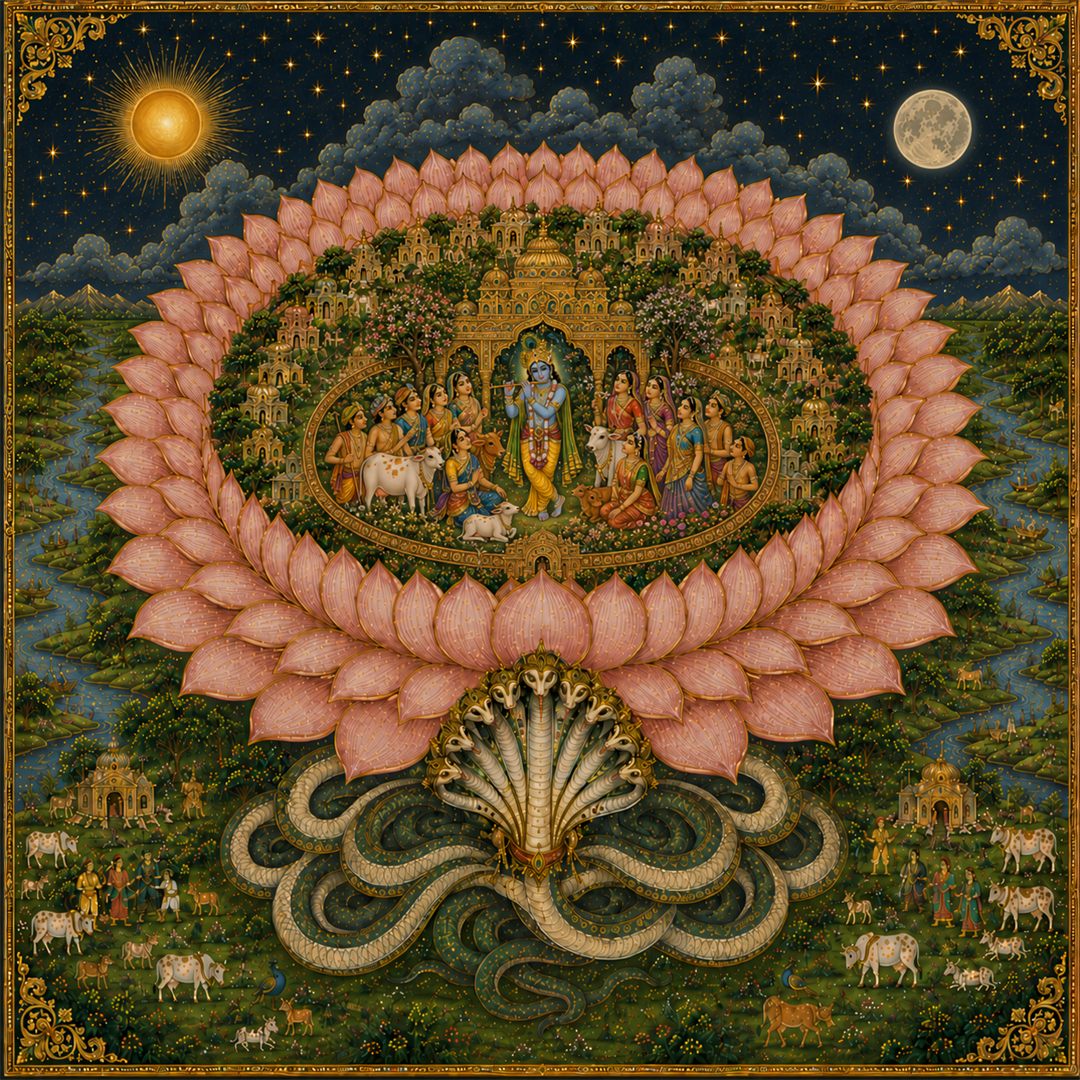
सहस्रपत्रकमलं गोकुलाख्यं महत्पदम् ।
तत्कर्णिकारं तद्धाम तदनन्तांशसम्भवम् ॥ २ ॥
sahasra-patra-kamalaṁ gokulākhyaṁ mahat-padam
tat-karṇikāraṁ tad-dhāma tad-anantāṁśa-sambhavam
The supreme abode, a lotus with a thousand petals, is known as Gokula. The pericarp of that lotus is Śrī Kṛṣṇa’s abode, and that realm is manifested through a portion of Ananta.
sahasra-patra—of a thousand petals; kamalam—lotus; gokulākhyam—known by the name Gokula; mahat-padam—the supreme, most excellent abode; tat-karṇikāram—whose pericarp is that; tad-dhāma—His abode; tat—that realm; ananta-aṁśa—through a portion of Ananta; sambhavam—manifested.
Dig-darśinī-ṭīkā
Jīva Gosvāmī
Now, beginning with the words sahasra-patram and so on, Brahmā describes the eternal abode that substantiates Kṛṣṇa’s nature as just described.
The lotus whose petals number in the thousands is itself composed of cintāmaṇi gems, as will later be stated in the words bhūmiś cintāmaṇi-gaṇamayī, “the ground is composed of multitudes of cintāmaṇi gems.” This is its form. And it is the mahat-padam, the greatest and most excellent abode. The meaning is that it is the the abode of the great Śrī Kṛṣṇa or the great devotees (mahā-bhāgavatas), and is of the nature of Mahā-Vaikuṇṭha1.
Since various kinds of such abodes are heard of, he specifies it by means of a distinguishing qualifier: gokulākhyam. The name gokula is a conventional designation, whose meaning is “the place where the cowherds reside.” According to the principle that conventional meaning overrides etymological meaning, the conventional meaning is understood here.
With this intention it is said in the Śrīmad-Bhāgavatam (10.10.39): bhagavān gokuleśvaraḥ. “Bhagavān is the Lord of Gokula.” Consequently, the later portions of this work should also be explained in a manner consistent with this understanding. This is the great abode suitable for the residence of Śrī Kṛṣṇa together with Śrī Nanda, Yaśodā, and the others. Their dwelling together with Him will be described further ahead.
Now the nature of that abode is stated beginning with tat. It is that realm whose eternal manifestation arises through a portion of Ananta, understood as a particular division of effulgence belonging to Baladeva.
This is also to be understood through the Tantra.
Alternatively, it is that realm where Śrī Baladeva, of whom Ananta is a portion, has His own manifestation and dwelling place.
Brahma-saṁhitā-prakāśinī
Bhaktivinoda Ṭhākura
(Here the transcendental Gokula-dhāma, the abode of Śrī Kṛṣṇa’s spiritual pastimes, is being described.)
Verse 2
Gokula is Kṛṣṇa’s supreme abode. It is eternally manifest through a portion of Ananta. That Gokula is a transcendental lotus possessing thousands of petals, and within it the whorl is Śrī Kṛṣṇa’s residence.
Goloka-dhāma, also known as Gokula, is not a created or temporary place. It is eternal and transcendental by nature, existing before, during, and after any material manifestation. The expression anantāṁśa-sambhavam indicates that the principle of infinitude (ānantya-dharma) is Śrī Kṛṣṇa’s śaiṣī-śakti,2 and Śrī Baladeva, who embodies Kṛṣṇa’s pastimes, is the shelter of that potency. The manifestation of Ananta or Śeṣa Bhagavān is one expression of this potency. Both the spiritual and material worlds are manifested through it.
Śrī Baladeva’s unlimited nature reveals itself in two ways. The first is spiritual infinity, manifest as unlimited transcendental abodes. The second is mundane infinity, manifest as unlimited inert material worlds. The material infinity, constituting the one-quarter manifestation, will be discussed later in its proper place. The infinite spiritual realm, comprising three quarters of Bhagavān’s opulence, is beyond all lamentation, mortality, and fear. It is fully self-luminous and composed entirely of pure conscious existence. This vast spiritual realm is also known as Mahā-Vaikuṇṭha or Paravyoma-dhāma.
Within that same spiritual infinity, in its most beautiful manifestation, Gokula or Goloka is eternally manifest as the abode of supreme sweetness.
Mahā-Vaikuṇṭha and Goloka are thus distinct manifestations of the one spiritual potency. Manifest through gradations of spiritual effulgence, this divine abode is of unsurpassed beauty and charm. It is sometimes called Mahā-Nārāyaṇa-dhāma or Mūla-Nārāyaṇa-dhāma. Thus Gokula, within Goloka, is the most excellent of all abodes.
This one abode exists simultaneously in two manifestations. In the spiritual realm it is resplendently present as Goloka, and within the material universe it appears as Gokula, Śrī Kṛṣṇa’s place of earthly pastimes. There is no fundamental difference between these two. As Śrīla Sanātana Gosvāmī writes in his Bṛhad-bhāgavatāmṛta:
yathā krīḍati tad-bhūmau goloke’pi tathaiva saḥ
adha urddhatayā bhedo’nayoḥ kalpate kevalam
“Just as Kṛṣṇa performs His playful pastimes in Gokula within the material universe, so also He performs the same pastimes in Goloka above.”
The only difference between Goloka and Gokula is conceived in terms of higher and lower situation. In all other respects they are one. Whatever exists in Goloka-dhāma in the spiritual realm is equally and splendidly present in Gokula, Śrī Kṛṣṇa’s place of earthly pastimes.
Śrīla Jīva Gosvāmī confirms this in the Ṣaṭ-sandarbha: Goloka and Gokula are non-different, but by the influence of Śrī Kṛṣṇa’s inconceivable potency, acintya-śakti, Goloka is situated in the highest territory of the spiritual realm, while the Gokula of Mathurā-maṇḍala is situated in the material universe of the one-quarter manifestation.
How the transcendental abode of the three-quarter manifestation can be simultaneously present in the inferior material world of the one-quarter manifestation lies beyond the capacity of the conditioned soul’s ordinary intelligence. It can only be understood through the grace of Śrī Kṛṣṇa’s acintya-śakti. Since Gokula is a transcendental abode, even though it appears within the universe of five material elements, it is not subject to any limitation imposed by mundane time and space. It remains in an unobstructed state as the supreme Vaikuṇṭha reality (parama-vaikuṇṭha-tattva). However, the conditioned soul, whose senses are absorbed in inert material nature, perceives the transcendental Gokula through material eyes.
A cloud may cover the eyes of an observer, but it cannot cover the Sun. The person standing in the shadow of that cloud sees, with ordinary vision, that the Sun appears to be covered. In the same way, the conditioned soul, whose senses and intelligence are veiled by material defects, inevitably superimposes the qualities of material nature upon the transcendental abode of Gokula. Only one whose consciousness has been purified through devotional service can perceive Gokula as it truly is.
The knowledge that produces a state of self-satisfaction (ātmāramatā) by negating material superimposition can never perceive the Vaikuṇṭha principle situated above the impersonal Brahman of diffused eternal existence, consciousness, and bliss.
Therefore there is no possibility of beholding Goloka or Gokula through the effort of jñāna alone, for those who pursue knowledge rely upon their own subtle vision in their search for truth and do not seek the grace of Kṛṣṇa, who possesses inconceivable potency. Efforts to attain Goloka-Vṛndāvana through such spiritual knowledge centered upon the self are therefore futile. Likewise, the endeavor of yoga, which belongs to the path of regulated action, does not qualify one for such grace. Consequently, these paths cannot carry one beyond kaivalya, the state of undifferentiated liberation, to seek the spiritual pastimes that exist above it.
Those who take shelter of pure devotion (śuddha-bhakti) alone receive the grace of Kṛṣṇa, who is endowed with inconceivable potency. Through Kṛṣṇa’s grace, the bondage of material nature is removed and the good fortune of beholding Gokula arises. Within this, perfection through devotion (bhakti-siddhi) is of two kinds: svarūpa-siddhi, the perfection of one’s eternal spiritual identity, and vastu-siddhi, the perfection of attaining the actual spiritual reality. At the time of svarūpa-siddhi, Goloka is beheld within Gokula, and at the time of vastu-siddhi, Gokula is beheld within Goloka. This reciprocal vision is a profound mystery. The attainment of pure love (prema) is svarūpa-siddhi; thereafter, when by Kṛṣṇa’s will both the gross and subtle material coverings of the conditioned soul are removed, vastu-siddhi takes place. In any case, until bhakti-siddhi is attained, Gokula appears distinct from Goloka in the realm of conceptual understanding.
Gokula, the eternal abode of Kṛṣṇa, is His eternal dwelling, manifest as a transcendental thousand-petalled lotus of endless spiritual variety.
Annotations
Bhakti Gauravani Goswami
Māyāpur and Vṛndāvana today appear very different from the Māyāpur and Vṛndāvana of the time of Śrī Caitanya Mahāprabhu and the Six Gosvāmīs. Much of their former rural simplicity has given way to high-rise buildings and relentless traffic, often creating the impression that the veil concealing the true nature of the dhāma from our vision has grown denser.
Yet beyond these external changes, that veil may seem denser still because of the inner condition we bring with us when we visit the dhāma. The modern pilgrim often arrives with a mind and senses overwhelmed by the ceaseless noise of the digital age and by countless distractions and temptations unknown to earlier generations.
As Bhaktivinoda Ṭhākura points out in his commentary, “the conditioned soul, whose senses and intelligence are veiled by material defects, inevitably superimposes the qualities of material nature upon the transcendental abode of Gokula.” If this was true in Bhaktivinoda Ṭhākura’s time, what to speak of those living in the twenty-first century, whose senses and intelligence are continually subjected to myriad forms of distraction.
But, Bhaktivinoda Ṭhākura does not leave us in despair. He assures us that the dhāma itself remains eternally pure and untouched, and that “one whose consciousness has been purified through devotional service can perceive Gokula as it truly is.” However dense the modern veil may appear, the remedy remains the same: śuddha-bhakti, pure devotional service.
.
Notes
- Bhaktivinoda Ṭhākura later distinguishes Mahā-Vaikuṇṭha from Goloka. Here the phrase “of the form or nature of Mahā-Vaikuṇṭha” indicates that Gokula possesses the fully transcendental nature of the spiritual realm, while the following word gokulākhyam identifies its particular character as Kṛṣṇa’s abode where the cowherds reside. ↩
- The potency of Śeṣa who is also known as Ananta (infinite). ↩